Volume II: Arcane & Magical Lexicon
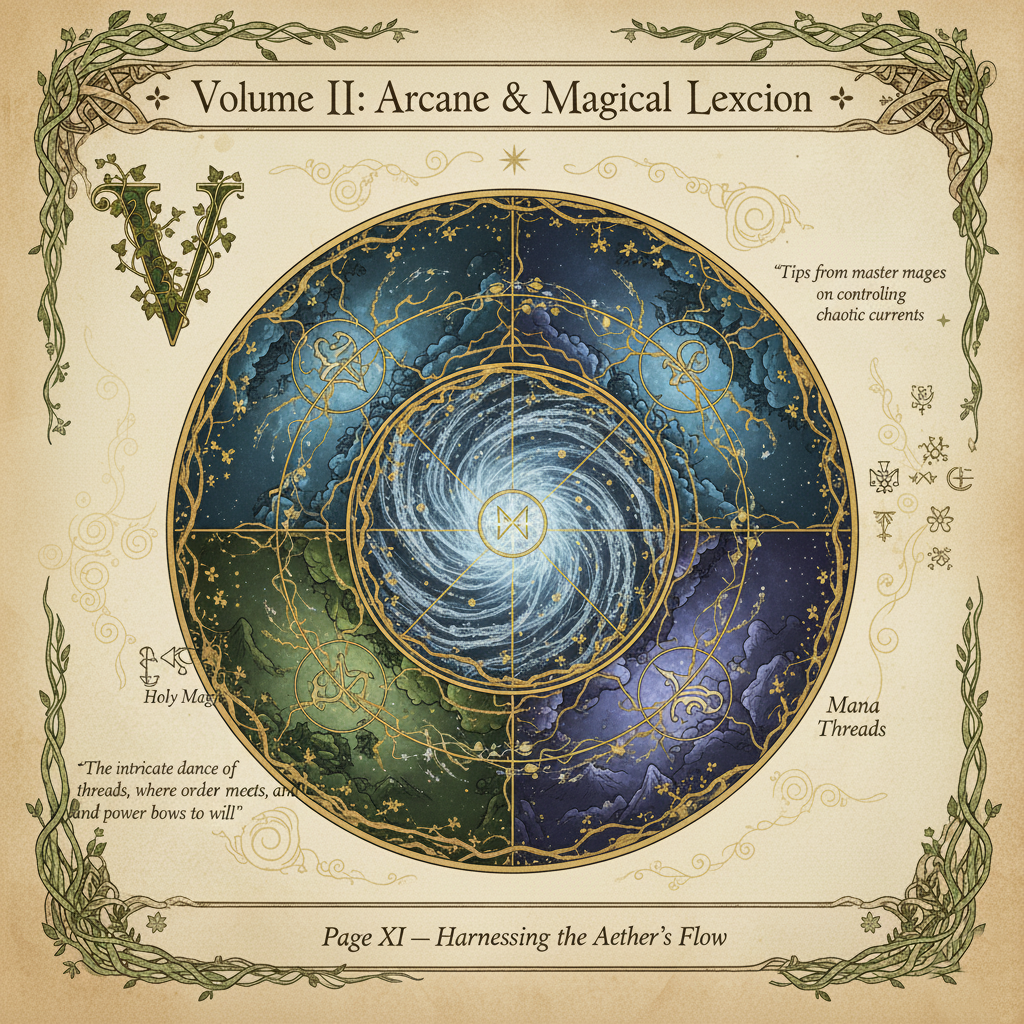
Volume II: Arcane & Magical Lexicon
Illustration: A wizard’s circle, with threads of light representing Holy Magic and Mana Threads.
Tips from master mages on controlling chaotic currents.
- Overview of Magic
- Origins of Arcane Power
- Divine vs Mortal vs Elemental Interactions
- Origins of Arcane Power
- The Orders of Magic
- Holy Magic
- Shadow Weaving
- Blood Alchemy
- Elemental Conduits: Air, Water, Fire, Earth
- Holy Magic
- Artifacts and Implements
- Starmetal Forged Relics
- Soul-Bound Items
- Mana Reservoirs
- Starmetal Forged Relics
- Ritual Magic
- Ceremonial Rites
- Binding Rituals
- Lunar & Solar Rites
- Ceremonial Rites

“Magic is not power—it is conversation with the world, and the world rarely whispers twice.”
— The Fifth Treatise of Aramun the Bound
✦ ✶ ✹ ✶ ✦
I. Overview of Magic
“Do not shout at the currents. Breathe with them. A magician who argues with the wind soon becomes dust.”
— Notes of Master Elra, Keeper of Threads
Origins of Arcane Power
The arcane did not begin—it persisted. It is the echo left behind when creation spoke itself into form. Where divine energy commands, arcane energy responds; it is the residual hum of existence waiting to be shaped.
Three primal sources of magic are recognized in Ideran scholarship:
| Source | Essence | Nature of Power | Risks |
| Divine Arcana | Pure, Intent-bound | Borrowed from gods or holy sites; channeled through faith. | Overuse invites sanctified madness—“the burn of belief.” |
| Mortal Arcana | Blood and Will | Drawn from the caster’s life and soul. | Depletion leads to soul-thinning—a gradual erosion of memory and self. |
| Elemental Arcana | Raw and Primal | Harnessed from nature itself—storms, seas, stone, flame. | Unpredictable; often consumes those who cannot harmonize essence with intent. |
Note:
“To draw without offering is theft. The world always takes payment.”
✦ The Nature of the Arcane: Origins of Power ✦
Origins of Power in Idera
“Magic is not learned. It is remembered.” — Archivist Lysander
Overview
All magic in Idera descends from the Breath of the First Dawn, when the gods shaped the mortal world and left behind the residue of their creation — Arcane Essence.
This essence, invisible and infinite, became the Weave, the unseen current through which all power flows.
Every living thing hums with it — not as possession, but as inheritance.
The Arcane is neither good nor evil. It is potential—unformed will, awaiting direction.
Its strength is determined by the alignment of three forces:
- Soul: the personal spark of divine origin.
- Emotion: the fuel that grants shape.
- Faith: the focus that commands it.
Together, these form the trinity through which all spellcraft is born.
The First Echo
According to the oldest hymns, when creation first spoke, its echo did not fade — it fractured.
Each fragment carried an aspect of divine power, forming the Four Pillars of Creation:
Light, Stone, Sea, and Shadow.
From these flowed the disciplines now known as the Core Magics — Holy, Nature, Verdant, and Chaos.
Mortals who attuned to these echoes became the first Magisters and Divine Houses, drawing their birthright from the fragments their ancestors swore to guard.
Thus, power in Idera is not merely energy — it is heritage bound to purpose.
Arcane Resonance
The Weave responds to emotion.
Joy stirs light, grief calls stone, rage rouses flame, and love summons growth.
This resonance binds the mortal soul to the divine pattern, allowing spellcraft to flow not through knowledge, but recognition — the instinctive remembering of what one’s essence once was.
Some say this is why all magic has a cost: each spell briefly reminds the soul of its divine origin — and how far it has fallen.
The Breach of Balance
When mortals learned to draw magic without reverence, the Weave fractured again, birthing Anomalies and Forbidden Currents — remnants of spells cast without harmony.
These distortions still wander Idera as Blightzones, Veil Storms, and Living Spells, each one an echo of divine power denied order.
Thus, the practice of magic became both art and penance.
To wield it is to risk remembrance — and in remembering, to risk unraveling.
Archivist’s Closing
“Magic does not serve. It endures.
And those who claim to master it merely borrow what the gods abandoned.”
III. Divine vs. Mortal vs. Elemental Interactions
Magic, when viewed from the divine eye, is a negotiation of will.
The following relationships define the major schools and dangers within the magical continuum:
- Divine Magic (The Commanding Current)
- Power flows from above to below.
- Practiced by clerics, saints, and war-priests of the Triad.
- Seeks purity—but its flaw is rigidity.
- Divine light burns not only darkness, but ambiguity itself.
- Power flows from above to below.
- Mortal Magic (The Binding Current)
- Power flows from within outward.
- The most common form of spellcraft is shaped by word, gesture, or blood.
- Seeks control—but its flaw is ego.
- Mortals often mistake ownership for mastery.
- Power flows from within outward.
- Elemental Magic (The Breathing Current)
- Power flows between—living equilibrium.
- Practiced by druids, shamans, and the Verdant Houses.
- Seeks balance—but its flaw is dependency.
- The world must consent, or it collapses upon the caster.
- Power flows between—living equilibrium.
III. Interference and Harmony
When these powers converge, their interactions birth either miracle or catastrophe:
| Combination | Result | Notation in Codex |
| Divine + Mortal | “The Blinding Path” — ultimate clarity, followed by self-erasure. | ⚝ |
| Mortal + Elemental | “The Verdant Pact” — the most stable union; foundation of nature-based Orders. | 🌿 |
| Elemental + Divine | “The Tempest Concord” — unstable storms of will; often worshiped as living phenomena. | ⚡ |
“Never weave three. The world has only two hands to hold what you summon.”
— Anonymous field mage, notes recovered from the Ash Vale
I. The Threefold Foundation of Spellcraft
| Layer | Function | Common Form |
| Sigilic | Structural integrity — defines shape of energy. | Runes, circles, geometric bindings. |
| Verbal | Cognitive focus — defines the intent or emotional resonance. | Words, chants, or mental formulae. |
| Somatic | Physical conductor — translates will into action. | Gestures, tools, movement, or ritual dance. |
Analogy:
Think of a spell as a bridge.
- Sigils = the blueprint
- Words = the command to build
- Gesture = the first stone laid
Remove one, and the structure collapses—or worse, stands crooked.
Sigils are the written grammar of the arcane. They are neither symbols nor mere drawings—they are agreements between mind and matter.
Regional Sigil Styles:
| Region | Style | Form Characteristics | Typical School of Use |
| Northern Realms | Runic Graven | Harsh, angular glyphs carved into stone or metal. | Earth, Binding, and Defensive magic. |
| Eastern Dominion | Sun Script | Circular patterns that spiral inward; reflects the path of solar cycles. | Fire, Light, and Purity spells. |
| Western Houses | Lunar Threads | Fluid, overlapping sigils drawn in silver or salt dust. | Shadow, Dream, and Memory magic. |
| Southern Tribes | Verdant Script | Living sigils traced with sap, ash, or blood; grows or fades with intention. | Nature, Life, and Blood rites. |
| Borderlands | Broken Geometry | Hybridized and chaotic; designed for adaptive combat. | Experimental or forbidden weaving. |
Note:
“A sigil drawn in fear will only ever summon fear.”
Speech in spellcasting is not language—it is alignment. Words anchor the mind’s will to the world’s frequency. The tone, rhythm, and breath are often more crucial than the actual meaning.
Types of Incantations
- Command Invocations — Direct imperatives. (“Burn.” “Rise.” “Sever.”)
- Used in combat or elemental control.
- Risk: Too forceful a tone fractures the Weave.
- Used in combat or elemental control.
- Harmonic Chants — Repetitive, melodic phrasing.
- Used in healing, weather shaping, or long-duration spells.
- Note: Two casters chanting out of sync can implode the resonance field.
- Used in healing, weather shaping, or long-duration spells.
- Silent Invocations — Wordless mental constructs.
- Reserved for the elite.
- Draws from soul rather than air; requires immense control.
- Reserved for the elite.
- Names of Power — Invoking the true name of an entity, place, or element.
- Ancient practice. Forbidden by the Lunar Edict.
- When spoken correctly, the world remembers you spoke it—and may never forget.
- Ancient practice. Forbidden by the Lunar Edict.
Also See: Linguistic Key of Symbols & Tongues
The body is the first conduit; tools only refine what already flows.
Somatic magic relies on rhythm and posture to shape energy—thus why older rituals resemble dance.
Forms of Somatic Expression:
- The Weaving Motion — For fine control; used in Mana Threading.
- The Spiral Hand — Invokes cyclical forces (wind, water, rebirth).
- The Hammer Fist — Commands grounding or breaking magics.
- The Open Palm — Sign of surrender; used to draw or yield power rather than impose it.
Tools of Focus
| Item | Use | Material Significance |
| Staff | Channeling elemental or divine forces. | Wood binds air and earth—creates harmony. |
| Ring | Seal for containment magic. | Metal preserves continuity of current. |
| Blade | Sacrificial and directional focus. | Fire and will condensed into steel. |
| Chalice | Vessel for mana or life essence. | Symbol of transference. |
| Mirror | Reflective or reversal rituals. | Used to contain shadow or redirect curses. |
“Every tool is a story given form. Know what story your hand tells before you raise it.”
| Region | Philosophy of Power | Representative Order or Practice |
| North (Stone) | “To endure is divine.” — magic as preservation. | Runewardens, the Iron Keepers. |
| East (Sun) | “To shine is to conquer.” — magic as expression of triumph. | The Dawn Priests, Solar Choirs. |
| West (Moon) | “To remember is to bind.” — magic as continuity and memory. | Moonbinders, the Silver Oathcasters. |
| South (Verdure) | “To decay is to renew.” — magic as natural cycle. | Verdant Sages, Rootcallers. |
| Borderlands | “To adapt is to survive.” — magic as invention and rebellion. | Threadbreakers, the Unnamed Loom. |
Field Record:
Transcript recovered from the ruins of Halrow:
“They cast without speaking—no gesture, no word—only a pulse in the air, like breath held too long. That’s when I knew they weren’t drawing from the world anymore. The world was drawing from them.”
“Power drawn through ritual is never one’s own. It is borrowed breath—and breath must be returned.”
4. Ritual Magic
The Ritual Arts: Ceremonial Magic, Pacts, and Offerings
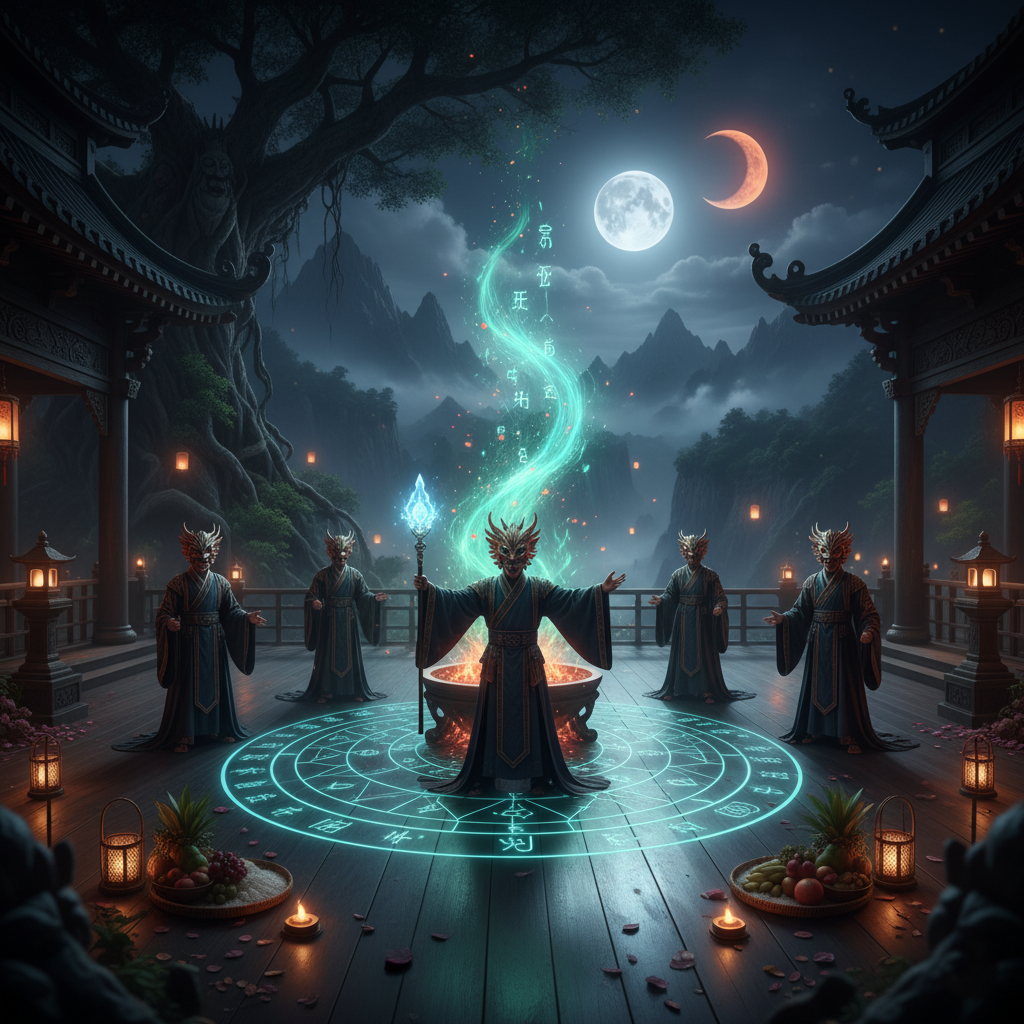
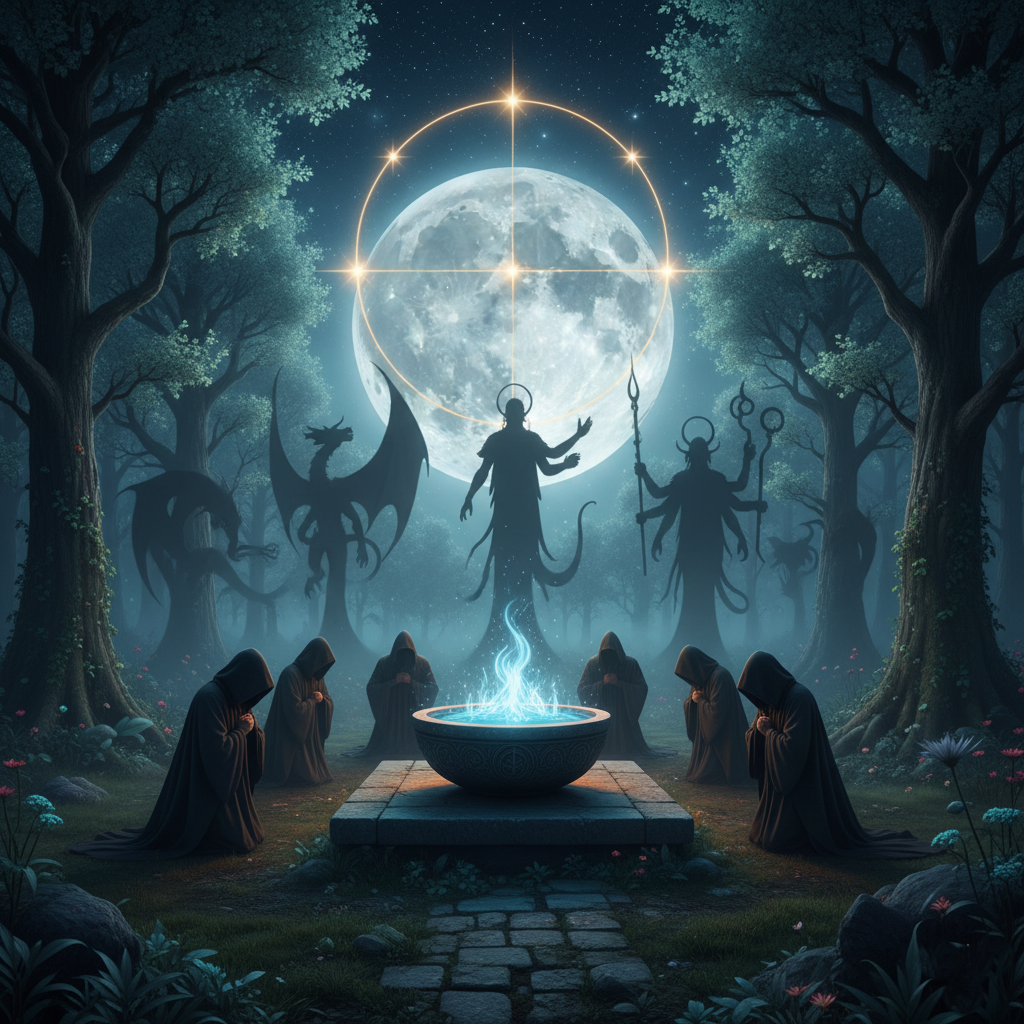
A moonlit clearing where robed figures kneel before a bowl of flame and water; their shadows stretch upward, taking the shapes of beasts and gods. In the sky above, four stars form a perfect circle — the mark of the Lunar Father’s gaze.
“It is not how you offer, but to whom you offer. The world answers in kind.”
— Scribed beneath a temple mosaic, Western Province
“A spell is an act of will. A ritual is an act of worship.”
— The Third Precept of Sinope, Goddess of War and Oaths
I. Purpose of Ritual
Unlike spontaneous spellcraft, ritual magic does not bend the world—it asks it to bend. Every ritual is a negotiation between mortal will and divine structure.
It requires:
- Time — alignment with celestial or elemental cycles.
- Witnesses — living or spiritual.
- Offering — energy, essence, or memory.
Rituals are recorded as both art and ledger; each offering creates a contractual echo that lingers within the Weave for centuries.
Core Tenet:
“In ritual, the hand does not command—it participates.”
II. Three Classes of Rituals
| Type | Description | Common Uses |
| Ceremonial | Performed by groups or Orders to reinforce divine bonds. | Seasonal blessings, temple rites, oaths of allegiance. |
| Contractual | One-to-one exchanges between mage and entity. | Summoning, protection, empowerment. |
| Transmutive | Alchemical or sacrificial; seeks permanent alteration of form. | Resurrection, soul-binding, land purification. |
Every true ritual follows The Fourfold Preparation, known across all regions as The Aether Key:
- Sanctum — The space of performance. Must be aligned with the caster’s Soul Essence.
- Example: Holy mages prefer elevated or open-air sanctums; Shadow weavers require enclosed darkness or mirrorwater.
- Example: Holy mages prefer elevated or open-air sanctums; Shadow weavers require enclosed darkness or mirrorwater.
- Anchor — A symbolic or physical focus for the ritual’s energy.
- Stone altars, runic circles, ancestral relics, or living trees.
- Stone altars, runic circles, ancestral relics, or living trees.
- Offering — The exchange. Can be blood, mana, memory, or service.
- Lesser offerings sustain; greater offerings transform.
- Lesser offerings sustain; greater offerings transform.
- Invocation — The act of naming or calling.
- Begins the contract and seals the energy cycle.
- Begins the contract and seals the energy cycle.
Marginal Note:
“Never begin what you cannot end. The gods remember even when you do not.”
Pacts are the living heart of ritual art. They are mutual recognitions between beings of different essence—divine, mortal, or otherwise.
Classifications of Pacts
| Type | Binding Method | Risk |
| Divine Pact | Oath under celestial witness. | Spiritual taxation; overuse leads to “hollowing.” |
| Elemental Pact | Exchange of energy with primal forces. | Elemental imbalance; loss of emotional control. |
| Ancestral Pact | Communion with the dead. | Memory drift; identity erosion. |
| Infernal Pact | Trade with corrupted or lost entities. | Total subsumption of will; the entity lives through the caster. |
Recorded Covenant:
“I offered my name; it offered me fire.
Now the fire speaks when I dream.”
— Confession of the Burnt Monk, sealed text from the Eastern Conclave
Offerings are the currency of the metaphysical world. Nothing in ritual is free; even the smallest act requires equivalence.
| Offering Type | Equivalent Power | Typical Ritual Context |
| Incense / Aromatic Smoke | Minor spiritual appeasement. | Daily temple rites. |
| Blood (Personal) | Medium energy transfer. | Binding or protective rites. |
| Memory / Emotion | High metaphysical cost. | Dream or soul pacts. |
| Life Essence / Soul Fragment | Cataclysmic. | Resurrection, creation, or sealing rituals. |
Marginalia:
“The gods favor stories over gold. Speak your truth, and they may answer.”
Also See
Compiled from the Field Journals of Archivist Noen, Keeper of the Fifth Vault
“Power may be born from the soul, but its memory is kept in metal.”
Overview
Every civilization upon Idera leaves behind its magic not only in words, but in tools — the conduits, containers, and catalysts of divine inheritance.
These objects are known collectively as Implements of the Weave, divided into three principal classes: Starmetal-Forged Relics, Soul-Bound Items, and Mana Reservoirs.
Each is both artifact and scholar—holding its own laws, temperaments, and appetites.
Noen’s field notes describe them as “echoes that learned to listen back.”
🜸 Starmetal-Forged Relics
Composition: Meteoric alloys and celestial fragments, resistant to corrosion and corruption.
Function: Amplification and stability of magical channels.
Primary Users: Smith-Magi, Knight-Priests, and Lunar Artificers.
Forged from ore fallen through the Veil, Starmetal is said to remember the moment it touched creation.
Relics made of it often resonate with lunar frequencies, allowing seamless conversion of pure mana into structured form.
Examples:
- Warblade of the Moonwalker — twin relics attuned to lunar resonance.
- Seraphim Chains — blood-forged links capable of binding divine entities.
- Jinseiga — an heirloom blade whose resonance echoes its wielder’s heart.
Hazards:
Overuse can fracture the Starmetal’s memory, causing the artifact to “remember” prior commands, replaying attacks or spells unbidden.
Some ancient forges were silenced after their creations began to dream of battle.
“Starmetal hums softly at rest, as if waiting for the world to end again.” — Noen’s Third Field Note
💠 Soul-Bound Items
Composition: Organic or spiritual resonance fused directly with a living soul.
Function: Symbiosis; shared consciousness between wielder and artifact.
Primary Users: Bloodline heirs, bonded mages, and divine avatars.
A Soul-Bound item is not crafted—it is grown. It forms during ritual convergence between artifact and bearer, binding essence to essence.
Its temperament mirrors its owner: calm when they are calm, furious when they falter.
Examples:
- The Childhood Gift — an amulet linking Daichi and Umbra through mirrored wolves.
- Aegis Body Armor — living armor breathing with its master’s pulse.
- Grimoire of the Moonwalker — a sentient tome that learns from its reader.
Hazards:
Should its bearer die, the soul-bound item may linger—half-alive, whispering the last memories of its bond.
Some have been found wandering, echoing phrases of grief for centuries.
“To bind an artifact to one’s soul is to give it the right to mourn you.” — Noen’s Marginalia
🔮 Mana Reservoirs
Composition: Crystalline cores, divine bones, or ley-reactive minerals.
Function: Storage and redirection of mana; stabilizes high-intensity ritual casting.
Primary Users: Archivists, Alchemic Engineers, Ritualists of the Silent Order.
Mana Reservoirs are the lifeblood of great magical engines, temples, and relic forges.
They gather excess ambient energy and release it with precision, allowing mortals to mimic the power of gods without direct communion.
In ancient times, they served as batteries for floating citadels and continent-wide spells.
Examples:
- Altar of Mawthan — primal focus storing a Leviathan’s dream.
- Seed of Aluraine — condensed fragment of creation itself.
- Verdant Wells — underground mana hearts that feed groves and cities.
Hazards:
Reservoirs left unattended often awaken, developing instinctual behaviors—draining or defending mana flows like living creatures.
Some have grown territorial, spawning “mana storms” when threatened.
“Containment is a kindness. The Weave resents captivity.” — Noen’s Seventh Analysis
Summary Table — Implements of the Weave
| Type | Source | Primary Function | Notable Risk |
| Starmetal Relic | Celestial ore | Amplifies and stabilizes energy | Memory imprinting / sentience |
| Soul-Bound Item | Living soul essence | Shared power, emotional resonance | Fragmented consciousness after death |
| Mana Reservoir | Crystalline / leyline core | Stores and redistributes mana | Instinctual awakening or storming |
Closing Annotation — Archivist Noen
“Artifacts are not merely tools; they are questions with weight.
They ask what we are willing to let survive us.
The gods forged the first one, and then spent eternity trying to forget why.”
The North — Stone and Silence
Rituals are silent and enduring. Stones are carved with the name of the vow and buried. The earth becomes witness.
Common Rite: The Stone Sleep — vow of loyalty sealed within the ground; the land itself enforces betrayal with illness.
The East — Fire and Dawn
Rituals focus on renewal and illumination. Offerings of flame and song are made at sunrise.
Common Rite: The Fire Ascension — where warriors burn their sigils to ascend into divine favor before battle.
The West — Moon and Memory
Rituals involve shared silence and reflection beneath moonlight. Memories are written in salt upon black water and left to dissolve.
Common Rite: The Binding Bath — shared between lovers or warriors; seals loyalty or affection through water’s reflection.
The South — Root and Verdure
Rituals honor decay and rebirth. Offerings are buried in soil or ash, symbolizing transformation.
Common Rite: The Rebirth Feast — food shared with the dead before spring planting; a promise of cycles renewed.
The Borderlands — Flux and Survival
Rituals are pragmatic, hybrid, and often improvised.
Common Rite: The Iron Prayer — using broken tools as offerings to the spirits of survival.
When the terms of a pact or ritual are breached, the Weave remembers the imbalance.
- Minor Consequences: Reversal of fortune, physical weakness, sudden loss of mana.
- Major Consequences: Spiritual dissonance, hauntings, or temporal collapse.
- Divine Retribution: The god revokes name-rights—the person becomes invisible to the Weave itself.
Field Record:
“He tried to undo his vow to the sea. When the tide came, it did not stop at his door—it swallowed his name.”
— Notes from the Western Mariner Archives