Wolfwater District
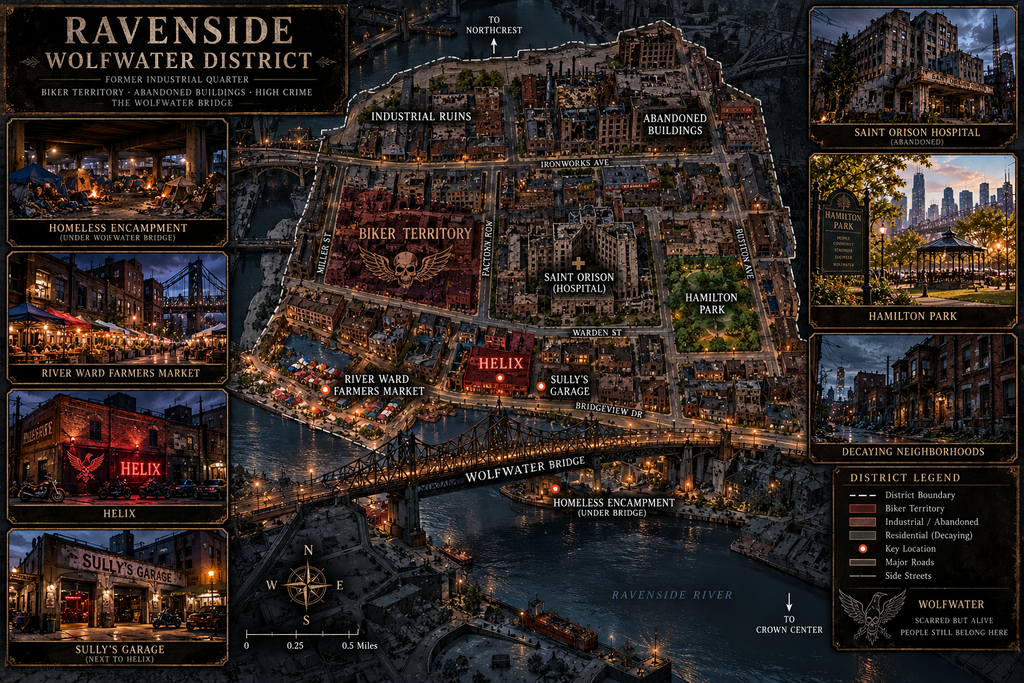
City: Ravenside
District Type: Former industrial quarter
Known For: Biker territory, abandoned buildings, high crime, the Wolfwater Bridge, River Ward, and Helix
Notable Locations: Helix, Sully’s Garage, Wolfwater Bridge, River Ward Farmers Market, Saint Orison Hospital, Hamilton Park
Wolfwater is the part of Ravenside people mention only when warning someone where not to go.
Situated across the river and divided from the wealthier districts by freight tracks, bridges, and decades of deliberate neglect, Wolfwater was once a thriving industrial community. Factories provided work. Warehouses crowded the riverfront. Neighborhood businesses supported families who had lived there for generations.
Then the factories closed.
Jobs disappeared first. City funding followed. Buildings emptied, roads deteriorated, and entire blocks were abandoned to weather, squatters, and men willing to conduct business beyond the reach of law. Ravenside continued growing around Wolfwater, building financial towers, hospitals, parks, and gated estates while leaving the district to rot in plain sight.
Wolfwater did not die.
It simply learned to survive without permission.
Wolfwater is a patchwork of aging brick buildings, condemned apartment blocks, boarded storefronts, narrow alleys, and vacant lots overtaken by weeds. Murals cover crumbling walls. Motorcycles line the curbs outside bars and garages. Streetlights flicker when they work at all.
The river carries the smell of mud, oil, and rust through the district. Freight trains pass at all hours, shaking windows in buildings that should have been demolished years ago. Sirens are common, though police vehicles rarely remain longer than necessary.
Crime is high, but the district is not lawless.
Wolfwater has laws.
They are simply not Ravenside’s.
Respect territory. Pay what you owe. Do not bring trouble to another person’s door. Never confuse hospitality with weakness. Most importantly, understand that people remember what the police and courts conveniently forget.
Reputation functions as currency. Loyalty offers better protection than money. Those without either learn quickly where they may walk, whom they may look at, and which doors should remain unopened.
The Wolfwater Bridge is both the district’s most recognizable landmark and its clearest symbol.
Above, thousands of vehicles cross the river each day, carrying commuters between Ravenside’s districts. Beneath it, a homeless encampment stretches between the concrete supports. Tents, tarps, mattresses, salvaged chairs, and metal barrels form a settlement largely ignored by the city.
The camp is harsh, particularly during winter rains and periods when the river rises. Theft and violence occur, but so do acts of stubborn generosity. Food is divided. Fires are shared. New arrivals are warned about dangerous men, unsafe sleeping places, and police sweeps.
The people living beneath the bridge are treated as invisible by those passing overhead.
Wolfwater sees them.
Femi once lived among them after leaving foster care at eighteen. She survived by staying quiet, watching everything, and making herself small enough to escape notice. When hunger finally drove her to search the garbage behind Helix, Malone found her.
That moment changed both of their lives.

Homeless encampment
River Ward occupies the portion of Wolfwater nearest the river. Its buildings are old, crowded together, and permanently stained by damp air. Some contain struggling businesses. Others house families, squatters, or criminal operations hidden behind ordinary doors.
The River Ward Farmers Market brings rare color to the district. Local growers and merchants sell produce, bread, meat, flowers, spices, clothing, and secondhand goods beneath patched awnings. The market draws people from throughout Wolfwater and occasionally from wealthier districts seeking inexpensive food or the thrill of visiting somewhere considered dangerous.
For residents, it is more than a market.
It is where news travels, favors are exchanged, and unfamiliar faces are noticed. An argument at one stall can become common knowledge throughout the district before sunset. Information is rarely free, but almost everyone accepts payment in forms other than money.
Femi enjoys the market because its noise allows her silence to pass unnoticed.
Daemon dislikes it because crowds provide too many places for danger to hide.

Farmer’s Market
Helix stands at the rough-beating heart of Wolfwater.
Owned by Malone, the establishment functions as a bar, biker clubhouse, meeting place, refuge, and unofficial court. The building is weathered rather than welcoming. Motorcycles crowd the pavement outside. Music and conversation spill through the doors long after midnight.
Inside, loyalty matters more than appearance.
Malone runs Helix with a firm hand and a strong memory. He knows who can be trusted, who owes money, and who should never be served alone. Marta Cappica helps maintain order through quiet observation and the unnerving certainty that she has already noticed whatever someone hoped to conceal. Older bikers such as Cutter carry the district’s history in scars, grudges, and stories told over whiskey.
Daemon Pallid occupies the darkest corner.
Before Femi, he was a feared presence who drank Jack Daniel’s on the rocks and watched the room from behind long blond hair. His reputation kept most people at a careful distance. He had once been an executioner for the Silent Order, and Wolfwater understood that some rumors were safer left unconfirmed.
Femi changes the shape of his silence.
She works inside Helix, waiting tables, cooking, baking, and slipping through crowded rooms with such quiet grace that Daemon privately calls her his little ghost. No one else uses the name for her. Malone gives her a room behind the clubhouse and the first stable home she has known since childhood.
Helix becomes the place where she is fed, protected, and allowed to exist without explaining why she cannot speak.
It is also where Daemon first begins watching her.
Sully’s Garage stands beside Helix, close enough that the two establishments share noise, customers, and trouble. The garage repairs motorcycles and cars, though some vehicles arrive with damage better left unexplained.
Its yard is crowded with stripped frames, rusted parts, oil drums, and machines waiting to be rebuilt. Sully knows engines, but he also knows the district. People talk while waiting for repairs. License plates are remembered. Unfamiliar vehicles are noticed.
Anyone attempting to watch Helix from the street must first avoid being noticed by the garage next door.
Few succeed for long.
Saint Orison was once Wolfwater’s primary hospital.
Now it stands abandoned.
The windows are broken or boarded. Water has damaged several floors, and weeds split the pavement around the entrances. The city has promised demolition or redevelopment more than once. Nothing has happened.
Children dare one another to enter. Criminals use portions of the building for meetings, storage, and temporary shelter. Former patients claim old equipment remains in sealed rooms, though no one agrees on what has been removed and what was simply left behind.
Saint Orison is a monument to Wolfwater’s abandonment. Ravenside did not merely close a hospital.
It informed an entire district that its people were no longer considered worth saving.

Hamilton Park is battered but alive.
Its benches are scarred, the playground equipment is old, and the grass grows unevenly. Nevertheless, families gather there. Children play beneath the supervision of adults who keep one eye on the street. Older residents occupy familiar benches, feeding birds and remembering what the district looked like before the factories closed.
Community gatherings, memorials, and informal markets occasionally fill the park. Motorcycle clubs sponsor food drives there, often providing more reliable assistance than official city programs.
Hamilton Park represents something Wolfwater protects fiercely: the right to possess ordinary joy in a place outsiders have already condemned.

Wolfwater residents are accustomed to being judged by their address.
People from Crown Center call the district violent. Northcrest considers it uncivilized. Politicians visit during elections, pose for photographs beside damaged buildings, promise renewal, and disappear before the pavement dries beneath their polished shoes.
The district has responded by becoming deeply suspicious of outsiders and fiercely protective of its own.
Its residents are mechanics, bartenders, market vendors, laborers, sex workers, former soldiers, bikers, addicts, fugitives, parents, and children. Some are dangerous. Some are desperate. Many are both.
Kindness exists in Wolfwater, but it is rarely soft.
It looks like a meal placed before someone without asking whether they can pay. A locked room offered for the night. A motorcycle escort home. A warning delivered before danger arrives. A body standing between a frightened young woman and the men attempting to corner her.
Protection is love translated into the district’s native language.
Wolfwater’s Reputation
Beyond the district, Daemon is known as the Devil.
Within it, his reputation becomes inseparable from Femi.
When he calls her my girl, the words move through Wolfwater faster than any official announcement. Men lower their eyes when she passes. Stories spread that Daemon has claimed a woman, taken a wife, or found the only living soul capable of calming what lives inside him.
The rumors are inaccurate in detail but correct in meaning.
Femi is no longer alone.
To threaten her is to threaten Malone, Marta, Helix, and the most dangerous man Wolfwater has ever welcomed home.
Character of the District
Wolfwater is not merely Ravenside’s poorest district. It is the evidence of the city’s betrayal.
Every abandoned building records a broken promise. Every tent beneath the bridge represents someone Ravenside decided not to see. Every motorcycle outside Helix belongs to a person who learned that survival often requires building a family from the discarded.
The district is violent because violence was done to it first.
It is suspicious because trust has repeatedly been used against it. It protects fiercely because no one else is coming. Wolfwater does not offer innocence, comfort, or easy redemption.
It offers shelter.
It offers loyalty.
And if someone enters with cruel intentions, Wolfwater offers consequences.
Ravenside may consider Wolfwater a stain upon the city.
Wolfwater knows better.
It is the scar proving the city survived the wound.