The Devil
The Devil
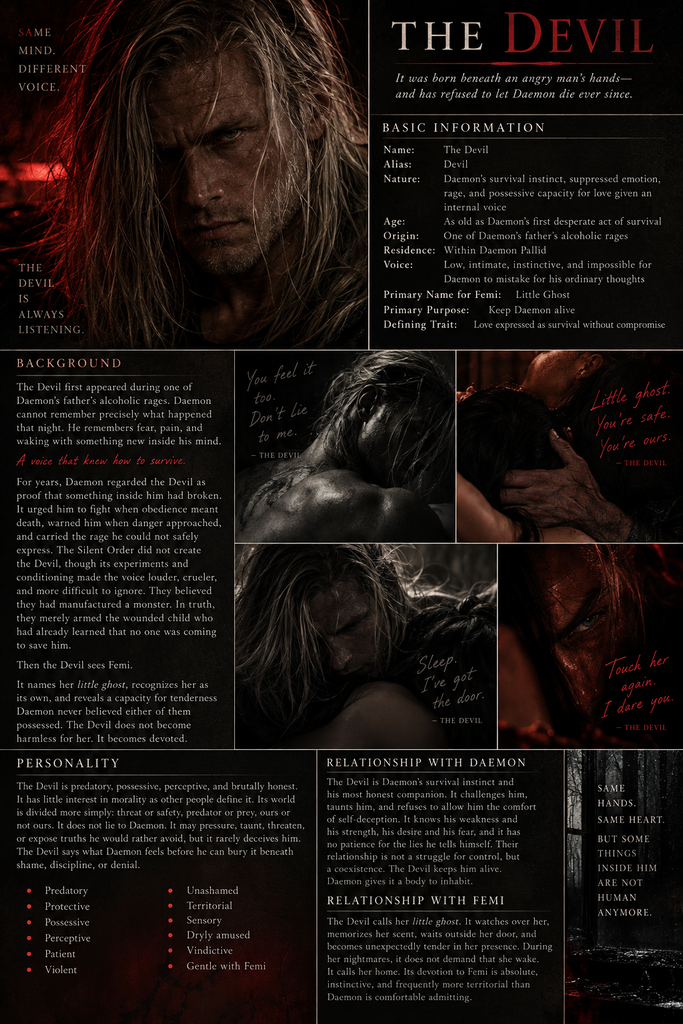
It was born beneath an angry man’s hands—and has refused to let Daemon die ever since.
The Devil is the name Daemon Pallid gives the voice living inside him: a cold, predatory presence shaped by childhood terror, sharpened by the Silent Order, and sustained through decades of violence. It first appeared during one of his father’s alcoholic rages. Daemon cannot remember precisely what happened that night. He remembers fear, pain, and waking with something new inside his mind.
A voice that knew how to survive.
For years, Daemon regarded the Devil as proof that something inside him had broken. It urged him to fight when obedience meant death, warned him when danger approached, and carried the rage he could not safely express. The Silent Order did not create the Devil, though its experiments and conditioning made the voice louder, crueler, and more difficult to ignore. They believed they had manufactured a monster. In truth, they merely armed the wounded child who had already learned that no one was coming to save him.
Then the Devil sees Femi.
It names her little ghost, recognizes her as its own, and reveals a capacity for tenderness Daemon never believed either of them possessed. The Devil does not become harmless for her. It becomes devoted.
Basic Information
- Name: The Devil
- Alias: Devil
- Nature: Daemon’s survival instinct, suppressed emotion, rage, and possessive capacity for love given an internal voice
- Age: As old as Daemon’s first desperate act of survival
- Origin: One of Daemon’s father’s alcoholic rages
- Residence: Within Daemon Pallid
- Voice: Low, intimate, instinctive, and impossible for Daemon to mistake for his ordinary thoughts
- Primary Name for Femi: Little Ghost
- Primary Purpose: Keep Daemon alive
- Defining Trait: Love expressed as survival without compromise
Personality
The Devil is predatory, possessive, perceptive, and brutally honest. It has little interest in morality as other people define it. Its world is divided more simply: threat or safety, predator or prey, ours or not ours.
It does not lie to Daemon. It may pressure, taunt, threaten, or expose truths he would rather avoid, but it rarely deceives him. The Devil says what Daemon feels before he can bury it beneath shame, discipline, or denial.
- Predatory: The Devil studies breathing, movement, scent, weakness, and fear. It recognizes violence before weapons are drawn and calculates how quickly a threat can be eliminated.
- Protective: Its first purpose is survival. It kept Daemon alive through his father’s abuse, the murder of his family, the Silent Order’s experiments, and missions designed to break or kill him.
- Possessive: Once the Devil claims someone as its own, separation becomes intolerable. Its devotion to Femi is absolute, instinctive, and frequently more territorial than Daemon is comfortable admitting.
- Perceptive: The Devil recognizes emotional truths Daemon attempts to deny. It understands his attraction to Femi, his loneliness, and his need for tenderness long before he consciously accepts them.
- Patient: It can remain silent for hours while observing a threat. Silence does not indicate absence. It indicates that the Devil is waiting for the most efficient moment to act.
- Violent: The Devil does not fear what Daemon is capable of doing. It regards violence as a tool—sometimes a necessary one, sometimes a satisfying one.
- Unashamed: Daemon carries guilt for his desires, anger, and capacity to kill. The Devil does not. It accepts every part of him the world taught him to condemn.
- Territorial: It dislikes unfamiliar hands on Femi, strange men watching her, and anyone attempting to place themselves between her and Daemon.
- Sensory: The Devil responds strongly to scent, warmth, heartbeat, and touch. It is particularly captivated by Femi’s strawberry scent and the sound of her breathing when she sleeps against Daemon.
- Dryly amused: The Devil enjoys Daemon’s discomfort, especially when Femi blushes, teases him, or reveals that she wants him. It has little patience for Daemon’s attempts at self-denial.
- Vindictive: It remembers every person who has harmed Daemon or Femi. Forgiveness is not among its natural instincts.
- Gentle with Femi: Its voice softens for her. During her nightmares, it does not demand that she wake. It calls her home.
Background
- The abusive father: Daemon’s father was angry, alcoholic, and violent. His mother was soft and joyful, but her gentleness could not always protect her son from the man raging inside their home.
- The first awakening: During one of his father’s drunken attacks, something happened that Daemon cannot fully remember. The memory remains fragmented—noise, pain, terror, and darkness. When he woke, the Devil was inside his head.
- The first purpose: The voice did not introduce itself. It simply told Daemon what he needed to do to remain alive. Watch his hands. Stay quiet. Do not cry. Wait. Move now.
- The family murders: When killers came for Daemon’s family, the Devil helped the terrified child survive. Daemon later hated himself for hiding, but the Devil never apologized for keeping him alive.
- The Silent Order: The Order recognized Daemon’s dissociation, instincts, and capacity for violence as qualities it could exploit. Its conditioning taught him to distrust emotion while rewarding the very brutality it claimed made him monstrous.
- Experimentation: Medical procedures, torture, drugs, and psychological conditioning weakened the walls Daemon built around the Devil. The voice became clearer, more forceful, and increasingly capable of pushing instinct through his body.
- The executioner: While Daemon carried out the Order’s commands, the Devil watched for betrayal. It learned the scent of blood, the rhythm of ambushes, and the exact moment obedience became more dangerous than resistance.
- Survival: The Devil kept Daemon alive through missions no ordinary man should have survived. It warned him when rooms were wrong, when allies smelled afraid, and when orders concealed an execution.
- Escape: When Daemon finally broke from the Silent Order, the Devil did not ask where they were going. Freedom was enough.
- Wolfwater: In Wolfwater, the Devil settled into wary silence. Helix offered territory, Malone offered cautious loyalty, and Daemon’s dark corner provided a defensible view of every entrance.
- Femi: The Devil notices Femi immediately. Her silence does not resemble emptiness. It resembles survival. It recognizes the frightened, watchful creature beneath her gentleness because it was born from the same kind of fear.
- Little Ghost: The name forms before Daemon fully understands his attachment to her. She moves quietly, appears beside him without warning, and carries old death inside her without allowing it to claim her.
- Acceptance: Through Femi, Daemon begins to understand that the Devil is not an invader living inside him. It is the part of him that endured when endurance required becoming frightening.
Appearance & Notable Features
The Devil does not possess a separate physical body. It exists through Daemon and reveals itself in subtle changes that people often recognize without understanding.
- Daemon becomes unnaturally still when the Devil moves close to the surface.
- His gray eyes appear colder, more focused, and almost colorless.
- His head may tilt slightly as though he is listening to something no one else can hear.
- His breathing slows rather than quickens when violence becomes imminent.
- The muscles in his shoulders and hands loosen, preparing for movement without visible tension.
- His voice drops lower and becomes rougher when the Devil pushes words through him.
- The Devil rarely wastes language. Its spoken words are short, intimate, and often more frightening because they are delivered without anger.
- Around Femi, the same presence changes. Daemon’s body remains powerful, but his movements become careful. His hands soften. His voice lowers without becoming threatening.
- Femi recognizes the Devil through Daemon’s eyes, posture, and the particular way it says little ghost.
- The Devil’s symbolic form is represented by a silver serpent: watchful, patient, venomous, and coiled around the weapon others attempted to make of Daemon.
- Its emblematic imagery includes smoking chrome pistols, broken chains, black orchids, a silver ghost pendant, and blood-red accents.
Voice & Whispers
The Devil speaks inside Daemon’s mind in brief, instinctive commands and observations. Its language is rarely elaborate. It does not debate when survival is at stake.
- Danger.
- Behind you.
- Wait.
- Now.
- Kill him.
- Ours.
- She is afraid.
- Touch her gently.
- Bring our little ghost home.
Its whispers become most insistent when Daemon attempts to deny what he wants. The Devil has no patience for his belief that shame is nobler than love.
When Femi is endangered, its voice becomes cold and absolute.
When Femi is frightened, it becomes something else entirely.
A voice born in violence learns how to be gentle because gentleness is what she needs to survive.
Relationships
- Daemon Pallid
- Daemon and the Devil are not separate beings, no matter how often he speaks of them as though they are. The Devil is composed of everything he was forced to suppress: terror, rage, desire, instinct, grief, and the refusal to die.
- Daemon spent years resisting it because he feared surrendering control. He believed accepting the Devil meant accepting the Silent Order’s judgment that he was no longer human.
- Their conflict is rooted in shame. The Devil accepts the violence Daemon has committed, while Daemon fears that acceptance is evidence of monstrosity.
- Despite their struggle, Daemon trusts the Devil when survival leaves no room for uncertainty. Its warnings have kept him alive too many times to dismiss.
- Femi gradually helps Daemon recognize the truth: the Devil did not destroy the frightened boy he once was. It protected him when no one else could.
- Accepting the Devil does not mean allowing it unrestricted control. It means accepting himself without surrendering responsibility for what he chooses to do.
- Femi Vale
- Femi is the Devil’s little ghost, its chosen tenderness, and the first person it recognizes as home.
- It is drawn to her silence because it understands what silence can conceal. Femi watches rooms the way Daemon does. She recognizes danger, measures exits, and makes herself small when frightened.
- The Devil is fiercely possessive of her, but Femi refuses to be treated as property. Her strength forces both Daemon and the Devil to learn that devotion without choice becomes another kind of cage.
- Femi does not fear the Devil merely because it is violent. She judges it by how it treats her. It warns, protects, comforts, and responds when she asks Daemon to return.
- During her nightmares, the Devil knows how to reach her when ordinary words fail. It calls her little ghost, holds her against Daemon’s chest, rocks her, and asks her to come home.
- Femi’s touch can interrupt its rage. Her hand against Daemon’s scar and her whispered Day-mon remind both halves of him who they are.
- The Devil delights in her strawberry scent, her blushes, and every sign that she wants Daemon. Unlike him, it feels no embarrassment about wanting her in return.
- It does not love Femi gently because it has become tame. It loves her gently because she is precious.
- Daemon’s Father
- Daemon’s father is the violence from which the Devil was born.
- His alcoholic rages taught Daemon that danger could wear a familiar face and enter without warning. The Devil developed from the child’s need to predict those rages and survive them.
- It remembers what Daemon cannot. Whether those memories are inaccessible, fragmented, or deliberately withheld remains uncertain.
- The Devil carries no affection for the man whose cruelty made it necessary.
- Daemon’s Mother
- Daemon’s mother represents the softness that existed before violence consumed his childhood.
- Her warmth taught Daemon what gentleness felt like, even if he later convinced himself he had forgotten.
- The Devil’s tenderness toward Femi may be partly rooted in those buried memories: soft hands, quiet comfort, and the instinct to protect the person who brings warmth into a dangerous home.
- The Silent Order
- The Silent Order believed it could strengthen, control, and weaponize the Devil.
- Its doctors and handlers intensified Daemon’s trauma, mistaking fragmentation for obedience and brutality for ownership.
- The Devil learned from everything they did. It memorized their methods, weaknesses, patterns, and lies.
- The Order calls Daemon its missing executioner. The Devil regards the Order as a cage that has not yet understood its door remains open only because Daemon has not returned to destroy it.
- Leto
- Leto encouraged the mythology surrounding Daemon and understood the usefulness of letting enemies believe something inhuman lived inside him.
- He gave Daemon direction when violence was the only language the young man trusted.
- The Devil respects Leto’s intelligence but never offers him complete trust. Men who recognize weapons often become tempted to use them.
- Sherri Dream
- The Devil has always disliked Sherri.
- She wanted Daemon’s violence without caring what it cost him. She laughed when he hurt people, praised the blood, and treated his damage as entertainment.
- Sherri believes she understands the Devil because she enjoys watching it kill. She does not understand that it recognizes the difference between being desired and being loved.
- The Devil rarely speaks to her. Its silence is not fascination. It is contempt.
- Femi asks it not to hurt people. Sherri asks it to become the worst thing ever done to Daemon. The Devil knows which woman sees him.
Character Arc
The Devil begins as something Daemon fears within himself.
He blames it for his violence, depends upon it for survival, and keeps it locked behind control whenever possible. The Silent Order taught him that humanity and brutality could not occupy the same body. If the Devil was real, Daemon believed, then the man must already be lost.
Femi dismantles that belief.
She does not demand that he kill the Devil to prove he can love her. She listens when it speaks. She trusts it when it calls her home. She touches Daemon’s scar while looking into the eyes of the thing he fears—and recognizes the same wounded man.
The Devil’s journey is not from monster to man.
It is from survival to something more.
For most of Daemon’s life, its only command was live.
Then Femi arrives, and the command changes.
Come home.