Peachpit Projects
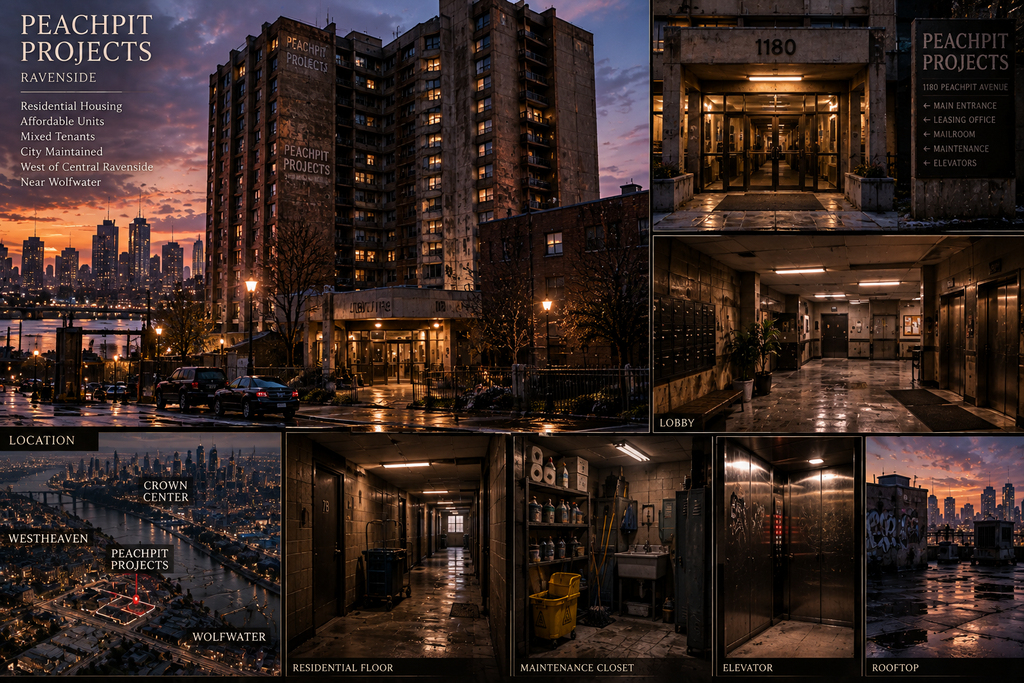
1180 Peachpit Avenue
City: Ravenside
Location: West of central Ravenside, near the edge of Wolfwater
Location Type: Public housing complex
Building Type: Aging high-rise residential building
Known For: Cheap apartments, unreliable elevators, crowded hallways, long-term tenants, and maintenance problems that are fixed faster when Femi handles them herself
Significance: One of Femi’s former homes and workplaces; a place where she survived by becoming indispensable
Peachpit Projects stands in the uneasy stretch of Ravenside where the city has not quite become Wolfwater but has already stopped pretending everything works.
The building rises above the surrounding blocks in stained concrete and aging brick, tall enough that its upper floors have an excellent view of a city most of its residents cannot afford. From certain windows, the towers of Crown Center glitter across the distance. At night, those buildings look close.
They aren’t.
Peachpit was constructed as affordable city housing decades earlier. Time, budget cuts, neglect, and too many temporary repairs have left their marks. Water stains darken portions of the exterior. Old balconies cling to the upper floors. Window air conditioners jut from apartments during the summer. Some windows glow warmly after dark while others remain covered with blankets, aluminum foil, or curtains bought years ago and never replaced.
The name PEACHPIT PROJECTS remains visible along the building’s exterior, faded enough that no one remembers the last time anyone bothered repainting it.
The front entrance sits beneath a heavy concrete overhang.
Two glass doors lead into a lobby that was probably attractive once.
Now the floors are permanently dulled from thousands of shoes. Rows of mailboxes cover one wall. Fluorescent lights hum overhead. A battered bench sits near the elevators, usually occupied by someone waiting for a ride, watching children, carrying groceries, or simply escaping an apartment that has become too crowded.
There are two elevators.
Residents trust neither.
One has a habit of stopping several inches above the floor. The other occasionally refuses to acknowledge the seventh floor exists.
Femi knew how to reset both.
She knew which elevator door required pressure near the bottom before it would close properly and which control panel could be temporarily convinced to cooperate with a screwdriver and several carefully chosen adjustments.
She also knew when neither elevator should be touched at all.
That knowledge made her more valuable than the building’s maintenance manual.
The residential floors are long, narrow corridors of painted concrete, old tile, and apartment doors carrying decades of individual lives.
Some doors are immaculate.
Some have children’s drawings taped to them.
Others have additional locks.
Music escapes beneath doors. So do arguments. Dinner smells travel through the hallways—garlic, frying onions, roasted meat, spices, coffee, bread.
Children race between apartments despite being told not to.
Older residents leave their doors cracked during summer because the hallways occasionally catch more air than their apartments.
Everyone knows everyone.
Or believes they do.
Privacy at Peachpit is less a right than a skill.
Femi became very good at it.
Femi worked as Peachpit’s janitor and handled much of its everyday maintenance.
Officially, her responsibilities were ordinary.
Cleaning hallways.
Mopping the lobby.
Emptying trash.
Cleaning stairwells.
Changing lightbulbs.
Keeping common areas usable.
The reality was considerably broader.
A leaking sink became Femi’s problem.
A broken cabinet hinge became Femi’s problem.
A tenant locked out because an ancient doorknob finally failed became Femi’s problem.
A toilet that wouldn’t stop running, a radiator that refused to heat, a hallway light flickering itself toward death, a garbage chute jammed three floors above the blockage—
Femi.
She learned the building because the building constantly broke.
The maintenance closet became almost a second home.
It is a narrow concrete room lined with metal shelving, cleaning chemicals, replacement fixtures, extension cords, buckets, plumbing supplies, spare locks, old paint cans, and tools accumulated through years of repairs.
Femi kept it immaculate.
Everything had a place.
Wrenches arranged by size.
Screwdrivers separated.
Cleaning supplies labeled.
Replacement bulbs stacked according to type.
Keys organized carefully enough that she could reach for the correct one without searching.
Other employees borrowed tools.
Femi knew when they failed to return them.
Because she was nonverbal, some residents initially mistook her silence for uncertainty.
They usually made that mistake once.
Femi could stand beneath a leaking pipe, study it for thirty seconds, disappear into her maintenance closet, return with exactly what she needed, and have the problem repaired before someone from the city maintenance department returned the original telephone call.
Eventually residents stopped asking whether she could fix something.
They simply found her.
A knock against the maintenance-room door might be followed by a tenant holding a broken faucet handle.
A child might appear because his grandmother’s kitchen light had gone out.
Someone would find Femi pushing her janitorial cart and point upstairs.
Femi would sigh, retrieve her tools, and follow.
It became part of Peachpit’s rhythm.
Femi’s apartment is one of Peachpit’s contradictions.
Nothing outside its door prepares anyone for what waits inside.
The hallway is institutional.
Her home is not.
Femi transformed the apartment into something resembling a dark Turkish palace.
Black suede furniture fills the living room. Silver lamps cast warm pools of light across dark surfaces. Pale-blue curtains soften the windows and move whenever a breeze reaches the upper floors. Ornate silver details appear throughout the apartment without making it cluttered.
The centerpiece is the rug.
Deep blue.
Silver threading woven through intricate patterns.
Under lamplight, the threads catch and shimmer as someone crosses the room.
Everything is immaculate.
Not expensive for the sake of appearing expensive.
Chosen.
Maintained.
Protected.
There are no piles of abandoned belongings. No dishes left overnight. No dust accumulating on shelves.
Femi spent too much of her life without control over where she lived.
Here, every object has a place.
And despite the apartment’s dark elegance, food changes the atmosphere completely.
Bread cooling in the kitchen.
A pot simmering.
Plates prepared.
Extra portions.
There is almost always enough for someone who wasn’t expected.
That becomes one of the quiet contradictions of Femi Vale.
A woman who once had nowhere permanent to sleep creates a home where strangers can be fed.


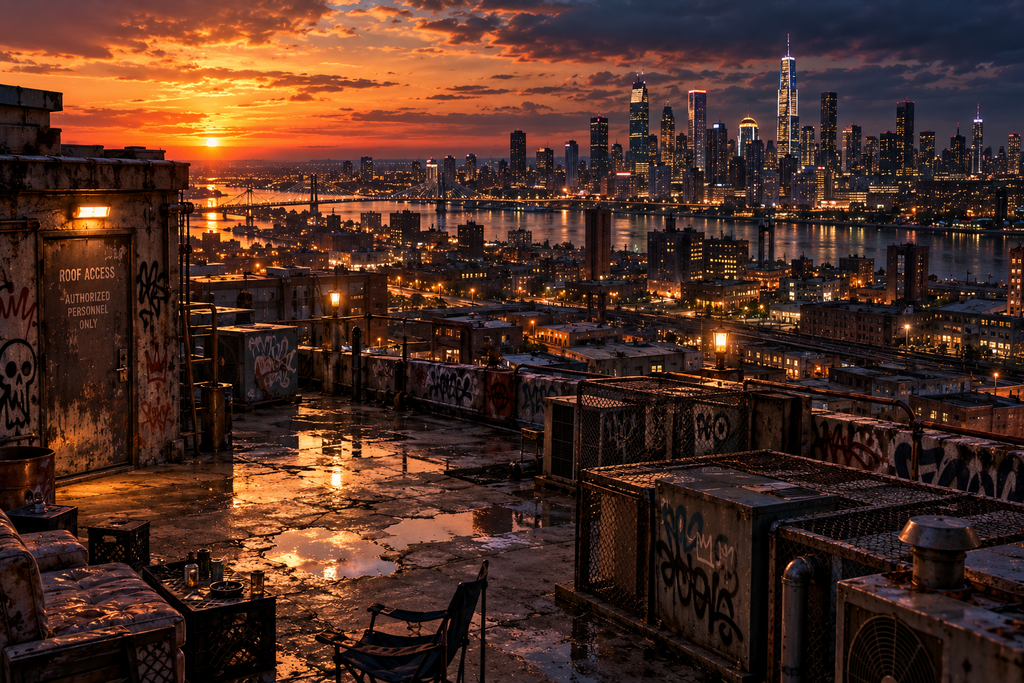
The rooftop is technically restricted.
This has never prevented residents from using it.
The access door sticks during humid weather. The concrete is cracked. Ventilation units hum behind protective cages, and graffiti covers portions of the utility structures.
But the view is extraordinary.
From there, Ravenside reveals itself.
Central Ravenside rises in the distance.
Crown Center glitters beyond it.
Wolfwater spreads lower and darker in another direction, industrial roofs and old buildings following the river.
At sunset, the differences between the districts temporarily disappear.
Everything becomes gold.
At night, they return.
Wealth announces itself in towers.
Poverty stays closer to the ground.
Peachpit stands between them.
That is perhaps what defines the building best.
It isn’t quite Wolfwater.
It certainly isn’t central Ravenside.
It exists in the forgotten middle, filled with people the city notices mainly when paperwork requires it.
Peachpit matters because it shows another version of Femi.
Not Daemon’s little ghost.
Not Malone’s little girl.
Not the silent woman someone mistakes for helpless.
Here, she is the woman with the keys.
The woman who knows which breaker controls the fourth-floor hallway.
The woman who knows Mrs. Alvarez’s radiator knocks twice before it begins heating properly.
The woman who knows the third-floor boy keeps losing his apartment key and the elderly man on eight pretends his kitchen faucet breaks because he is lonely and wants someone to sit with him for five minutes.
Femi rarely announces herself.
She simply appears.
Fixes what is broken.
Cleans what has been neglected.
Leaves things better than she found them.
And then returns to an apartment that smells of warm bread.
Peachpit Projects is not beautiful.
It isn’t safe because someone wrote secure building on city paperwork.
It isn’t efficiently maintained.
It isn’t a place people in Northcrest would ever envy.
But for a period of Femi’s life, it is hers.
And that matters.
Because Femi understands something about Peachpit that the officials who manage it never will.
Broken does not mean worthless.
Neglected does not mean empty.
And sometimes the person quietly carrying a toolbox down the hallway is the only reason the whole damn place keeps working.