Appendix A:

✦ Linguistic Key of Symbols & Tongues ✦
“The shape of a word reveals its ancestry; its silence, its allegiance.”
A Scholar’s Reference, compiled from the surviving archives of the Aetherveil Academy and the Western Monasteries.
| Tongue / Dialect | Script / Sigil Form | Region or Order of Use | Linguistic Character | Notes & Cross-References |
| Divine | Circular runes resembling orbiting suns | Spoken by gods, priests of the High Temples | Tonal, each word sung; divine intention alters meaning | Core of the Soul Essence terminology; origin of Pillar names. |
| Old Ideran | Angular glyphs carved in relief | Pre-Imperial ruins and holy relics | Pictographic; one glyph may signify concept and emotion | Survives in fragments through the Aetherveil hymns. |
| Celestial / High Celestial | Flowing script formed of continuous lines | Heavenly Orders, angelic emissaries | Fluid and paradoxical — written forward and backward simultaneously | Used in forbidden names like Iskandra and The Fifth Name. |
| Common Arcane | Precise sigil-script composed of line-threads | Mage Orders, alchemists, scholars | Geometric and mathematical; stable under mana flux | Standardized post-Sundering to record Mana Thread formulae. |
| Southern Shamanic | Spiraling symbols inked in living pigment | Southern jungles and marsh clans | Organic, animated; glyphs shift when read aloud | Used in Veilcraft rites and binding charms. |
| Noble Common | Stylized cursive blending Old Ideran and trade script | Western and Northern Houses | Elegant, political; favors formality and metaphor | Language of treaties such as The Silence Treaty. |
| Eastern / Imperial | Tall, upright runes with mirrored inflections | The Eastern Court of the Sun | Authoritative and ritualistic; used for decrees | Preserves the syntax of the Edict of Embers. |
| Abyssal | Jagged, broken sigils burned into stone or bone | Subterranean cults and ruins | Fragmented, incomplete — each word an invocation | Only a handful of phrases survive, like Whisperglass. |
| Unknown / Pre-Dawn | Lost | Pre-historical civilizations predating the Pillars | Theoretical, reconstructed from relic echoes | Believed to house words like Aesh’ra, capable of unmaking reality. |
✦ Addendum: On Translation ✦
Translating between divine and mortal tongues is perilous. Many scribes record only the phonetic echoes, not the words themselves, to avoid invoking what the word once did.
“To name a god in their true tongue is to summon the echo of their birth.” — High Translator Merin of the Third Era
“Every word of Kith is an act of breathing with the world.” — Archivist of the Vale
🜂 Structure of the Language
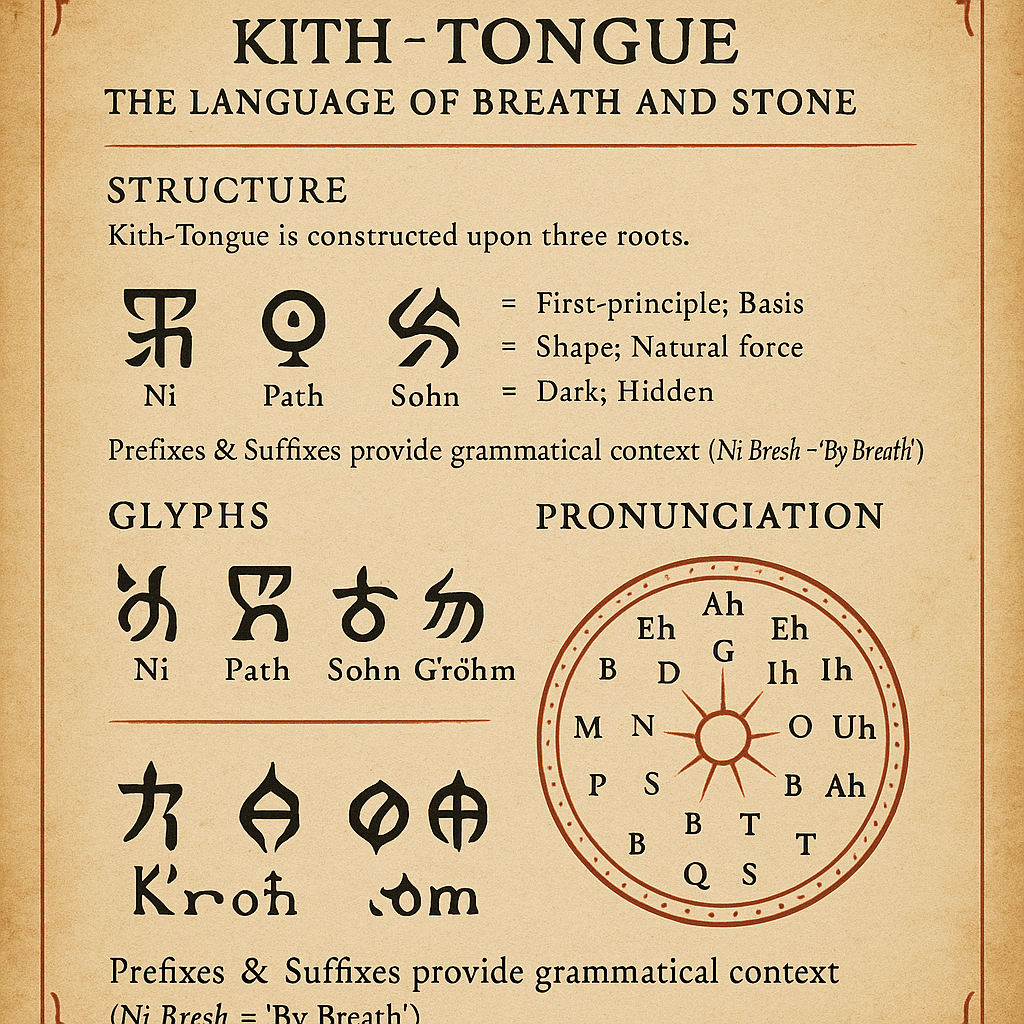
Kith-Tongue is built upon three elemental roots—each representing a metaphysical domain of creation:
| Glyph | Root | Domain | Conceptual Power |
| Ni | Breath | Soul / Spirit | Invocation and motion |
| Path | Shape | Form / Nature | Definition and alignment |
| Sōhn | Shadow | Memory / Hidden | Resonance and transformation |
The language is agglutinative, combining prefixes and suffixes to alter meaning. Each phrase balances Breath and Bone—the spiritual and material halves of speech.
🜃 The Five Canonical Glyphs
- Ni — First principle, the divine inhale
- Path — Structure and direction, the shaping of energy
- Sōhn — The unseen echo, lunar resonance
- K’rōth — The command, word of ignition
- G’hōhm — The return, word of unity and homecoming
🔮 Pronunciation Wheel: The Resonant Tones
The Vocal Wheel of Resonance aligns vowels with the four elemental harmonics:
- Ah / Eh — Air and Light (Dawn)
- Ih / Uh — Earth and Bone (Stone)
- Oh / Ahh — Shadow and Spirit (Dusk)
- Eh / Ihh — Growth and Return (Verdure)
Each line in Kith must be sung, not spoken—intoned with rhythmic breaths that imitate the wind through cavern halls.
🌑 Philosophical Significance
Kith-Tongue predates written magic. To speak in Kith is to temporarily unify with the Breath of Idera itself, drawing spiritual charge directly from the imprisoned Y’derah’s soul.
It’s said that a word uttered in perfect Kith carries three echoes:
- One for the world that hears.
- One for the gods who listen.
- And one for the earth that remembers.

“The world speaks in Breath, the soul answers in Shape, and memory carries the echo.” — Scribe-Tutor Vharen of the Still Halls
🜂 The Breath Root: Ni
At the heart of Kith grammar lies Ni, the Breath Root — the act of invoking spirit through vibration.
All phrases, chants, and incantations begin here.
It represents the moment where the soul and the land exchange energy — where Y’derah’s dormant pulse meets mortal intent.
🜃 Branches of Formation
1. Path (Shape Line)
- Suffix: Structural
- Function: Defines the physical or visible structure of will.
- Usage Example: Words invoking formation, direction, or stability.
“Ni-Path” — To shape through breath; to give body to intent.
2. Sōhn (Memory Line)
- Suffix: Transformative
- Function: Alters, reflects, or preserves what has already been formed.
- Usage Example: Words invoking echo, transformation, or memory.
“Ni-Sōhn” — To breathe remembrance; to awaken what sleeps.
🌗 The Modifiers of the Hidden Breath
| Modifier | Symbol | Function |
| Unseen Modifier | ● | Indicates invisible or dormant energy (used in subtle invocation). |
| Shadowed Modifier | ◐ | Channels power through reflection or indirect means (often used in Night Rites). |
| Illuminated Modifier | ◯ | Marks visible, radiant expression (used in open declarations or moonlit ceremonies). |
These modifiers determine whether a verse acts inward (hidden, personal, introspective) or outward (manifest, commanding, divine).
🔮 Linguistic Geometry
Every Kith phrase follows a Breathflow Pattern:
Root → Suffix → Modifier → Intent
For example:
Ni-Path-◐ would invoke the shaping of unseen energy, while
Ni-Sōhn-◯ would mean the memory illuminated — recalling something once lost into visible truth.
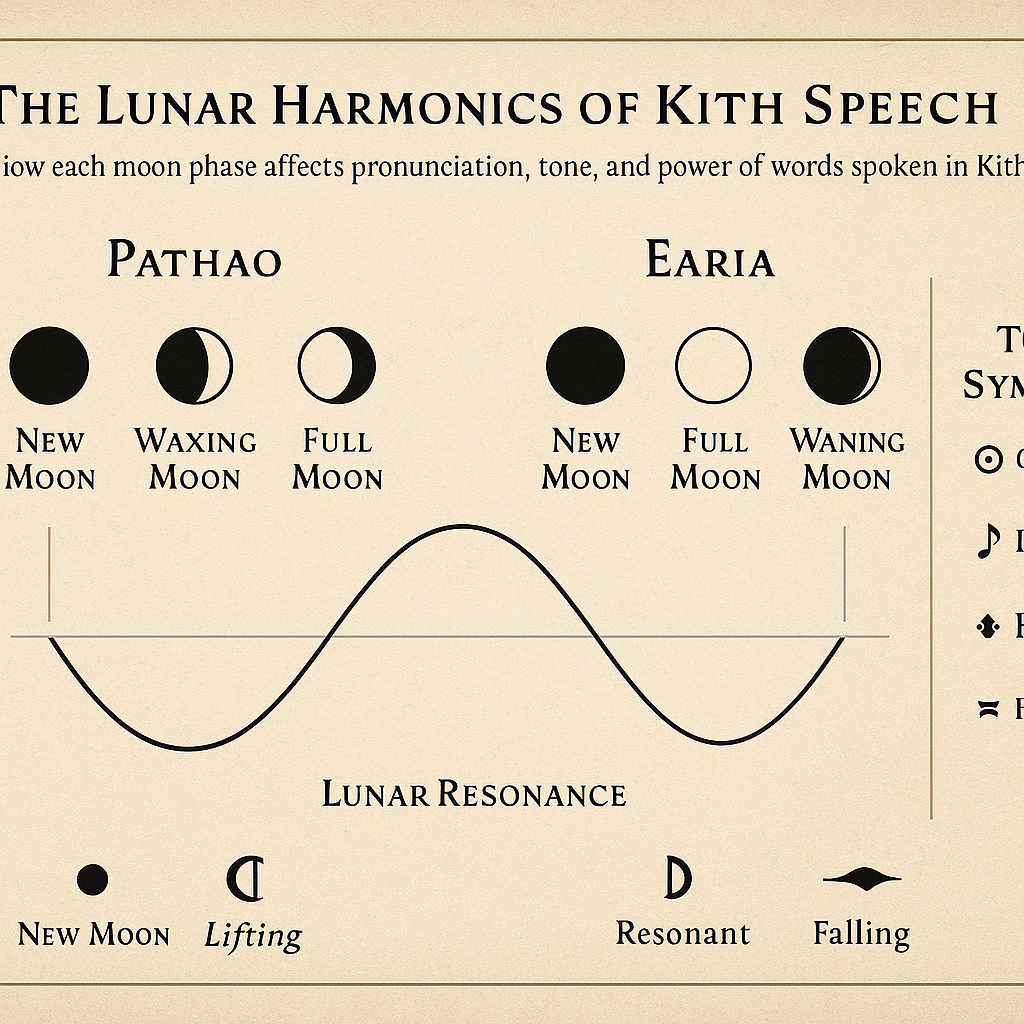
The final Codex page—“The Lunar Harmonics of Kith Speech”—completes the Trinity of Expression: Breath (language), Form (sigil), and Resonance (moonlight).
“Two moons breathe, and the world speaks between them.” — Archivist Eira of the Red Vein Sanctum
🌕 I. Dual Resonance of the Moons
Kith speech depends on the alignment of Pathao and Earia, the twin moons.
Their opposing gravities create waves of magical resonance that shape the tone and potency of any spoken verse.
| Moon | Aspect | Resonant Domain | Influence |
| Pathao | Stabilizing Moon | Shadow & Structure | Grounds speech, strengthens Binding and Shaping verbs. |
| Earia | Reflective Moon | Memory & Flow | Amplifies Transformation, Healing, and Revelation verbs. |
When both moons are visible, phrases acquire dual harmonics—a rare state where Kith words echo both across the spirit and physical plane.
🜂 II. The Lunar Resonance Curve
The central sine-wave diagram (as shown on the scroll) reflects vocal resonance through lunar rhythm:
- Crescendo (Waxing Phase) — Speech gains energy; best for invocation or creation.
- Apex (Full Moons) — Maximum harmonic clarity; the verse becomes self-sustaining for one breath cycle.
- Diminendo (Waning Phase) — Ideal for closure, sealing, or reflection rites.
- Void (New Moons) — Speech fades inward; introspective rituals and dream-binding.
🌗 III. Tonal Symbols and Vocal Modulation
Each phase carries a Tone Glyph, guiding the pitch and breath pattern:
| Symbol | Name | Vocal Tone | Meaning |
| ● | New Moon | Hollow | Invocation through silence; inward pull. |
| ☽ | Lifting | Rising tone | Awakening of latent power. |
| ◯ | Resonant | Steady tone | Full projection; balanced invocation. |
| 〰️ | Falling | Descending tone | Dismissal or sealing of intent. |
When used in scripture, tone symbols are placed above the Kith glyph to mark where the speaker should adjust breath depth or pitch.
🌙 IV. The Harmonic Pairing Principle
When Pathao is waxing and Earia waning, the verse achieves contrapuntal resonance—a rare harmony where the soul speaks in two frequencies simultaneously.
These moments are sought for the Eclipsera Verse, Lunar Oaths, and Rites of Reflection, allowing speakers like Umbra and Daichi to command both the seen and unseen veins of Idera.

The verse is a compact ritual command spoken in a language known as Kith-Tongue—the ancestral language shared by the Heartbound clans and the earth itself.
I. The Verse and Translation
| Kith-Tongue Verse | Literal Translation |
| “Ni Bresh, Ni Bone,“ | By Breath, By Bone, |
| “Ni Path’s-Umbral-Sōhn,“ | By Pathao’s Unshown Shadow, |
| “K’rōth Dār G’hōhm.“ | Let the Red Light Guide the Way. |
| Full Verse: “Ni Bresh, Ni Bone, Ni Path’s-Umbral-Sōhn — K’rōth Dār G’hōhm.” |
The common interpretation (“…by moon unshown—let the red light guide me home”) is the simplified phrase used for surface-level rites. The full, original verse contains the critical reference to Pathao (◯) and the command for guidance.
II. Esoteric Meaning (The Heartbound’s Command)
The verse commands the geomantic map to prioritize the bond forged by the Heartbound and to temporarily redirect the energy of the two moons.
| Line | Core Concept | Full Spiritual Meaning |
| Ni Bresh, Ni Bone | The Soul’s Claim | “I invoke the core essence of all Yokai, acknowledging that the land is built upon the Breath (spirit/life) and Bone (body/foundation) of Y’derah. I speak as a fundamental part of this world.” |
| Ni Path’s-Umbral-Sōhn | The Source of Power | “I invoke the shadow and hidden power of Pathao, the great, stabilizing Moon. I acknowledge that the true light needed for sight is not surface illumination, but the unseen power beneath the moon’s phase.” (This is the critical line that channels lunar energy). |
| K’rōth Dār G’hōhm | The Command | “I command the geomantic energy (the Red Light revealed during the eclipse) to rise from the earth and act as a temporary guidance path to the nexus. Let the map’s power serve my immediate, bonded purpose.” |
III. The Ritual Act and Resonance
When spoken by a true Heartbound (like Daichi or Umbra, whose souls are deeply intertwined with Yokai magic and the land), the verse functions as follows:
- The Breath: The act of speaking the verse projects the raw spiritual energy of the speaker outward, vibrating in harmony with the Vale of Stillness and the Ashen Vale (the Air/Breath sites).
- The Bone: The moon-salt and starmetal thrown into the crimson fire act as a physical key, focusing the resulting red illumination to resonate with the Scarlet Hollow and Red Vein Caverns (the Fire/Earth sites).
- The Activation: The combination causes the Sigil of Binding Breath to momentarily shift its focus from restraint to revelation. It does not break the seal, but it strains it, drawing the hidden paths out of Y’derah’s ancient memories and displaying them as visible, ghostly lines.
- The Dissonance (The Risk): When the verse is complete, the Chaos Lightning of the Crescent of Roots sigil reacts to the surge of Y’derah’s instinctual energy. If the speaker’s intent is impure or selfish, the chaos lightning violently rejects the command, causing a magical backlash.
The term Heartbound refers to the select few individuals descended from the First Yokai Pair who originally exhaled their souls together to bind Y’derah. They carry the original frequency of the Binding Breath in their very being, giving them unique spiritual authority.
I. The Lineage and Burden
- The Original Vow: The Heartbound lineage stems from the protectors who established the Sigil of Binding Breath. Their bloodline carries a genetic memory of the earth’s first stabilization and the terror of primordial chaos.
- The Mark of Resonance: Heartbound individuals do not naturally possess the Crescent of Roots sigil, but they carry an internal, invisible mark—the Echo of the Bone Map. This allows them to inherently sense the health of the ten sites and the pressure of Y’derah against the seal.
- The Burden of Secrecy: Their primary duty, managed by the Unaligned Elders at the Vale of Breath and Bone, is to protect the map’s existence and, crucially, to pass the Eclipsera Verse down to the next generation of protectors. They are forbidden from using their abilities for personal gain.
- The Scourge of the Soul-Debt: A Heartbound who breaks an oath (especially a Blood Pact) suffers a magnified spiritual consequence. Their Soul-Debt resonates not just with the other party, but with the Great Seal itself, risking a localized rupture of the geomantic pattern near the site of the betrayal.
II. Unique Spiritual Abilities
The Heartbound possess specific spiritual powers necessary for their role as the map’s overseers.
1. The Pulse Sense
- Ability: The ability to literally feel the vibrational frequency that restrains Y’derah. When near one of the ten hidden sites, they can sense whether the site’s anchor is weakening or holding firm.
- Function: This is how the Elders know when to mobilize a clan to repair a failing geomantic point. A feeling of “spiritual coldness” or a total lack of pulse indicates imminent failure.
2. Kith-Tongue Command
- Ability: The Eclipsera Verse is only effective when spoken by a Heartbound. Their vocal cords and spiritual essence are tuned to the language, allowing them to issue a direct, temporary command to the earth’s geomancy.
- Limitation: If a non-Heartbound attempts the verse, it results in nothing more than a localized magical discharge, as their spirit lacks the necessary authority to hijack the Great Seal’s functions.
3. Geomantic Synchronization
- Ability: The unique spiritual trait that allows the Heartbound to accept a Crescent of Roots sigil. Their aura is naturally receptive to complex, interwoven magics (like Daichi’s nature magic and Umbra’s chaos magic).
- Effect: This synchronicity is what makes the Shared Resonance possible. It ensures that when two individuals—one being Heartbound—bind their souls, their combined power is rooted and amplified by the immense energy of the land itself.
III. Daichi and Umbra: The Modern Case
The case of Daichi and Umbra is so significant because it represents the convergence of two incredibly rare bloodlines (Heartbound and Chaos Wielder) bound by the most powerful protective sigil.
- Daichi (The Protector): If Daichi carries the Heartbound lineage, his nature magic is not just wood and life; it’s land stabilization. His oath resonated so powerfully because he was already spiritually tuned to the Sigil of Binding Breath.
- Umbra (The Protected): Umbra’s chaos magic is seen as the unstable essence of Y’derah itself—a fragment of the primordial soul given form. The Crescent of Roots was the only way to ground and protect this immense, destructive power, making Daichi’s role not just protection, but containment.
Cross Reference: Varuun
Also See: The Bestiary of Idera, Volume I: Yokai and Elemental Beings.