Lunar Park Museum
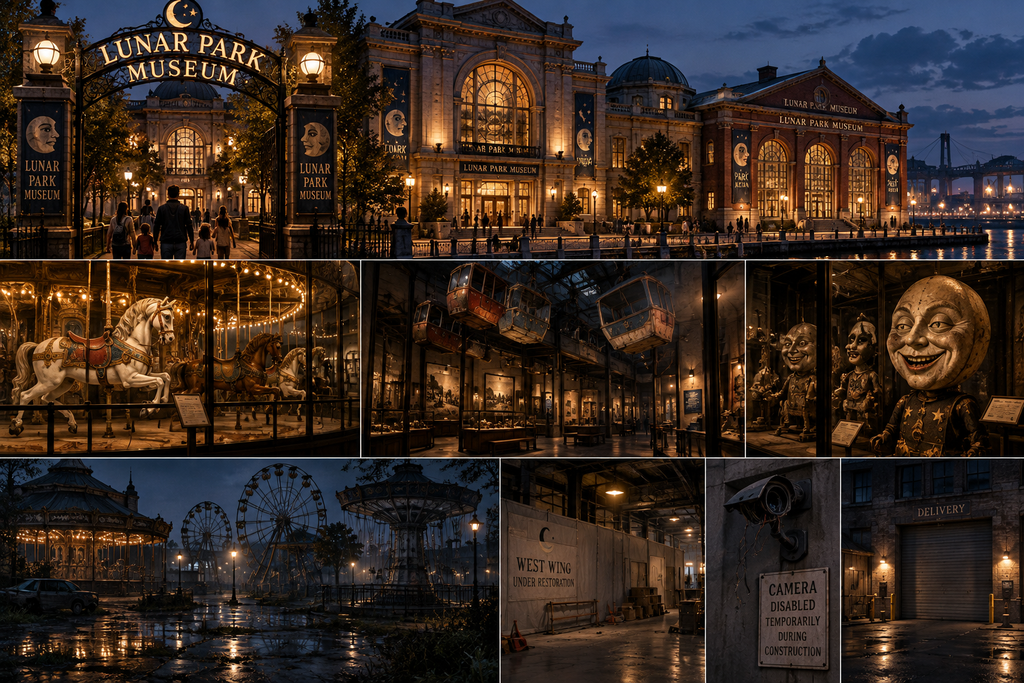
Location: Westheaven, Ravenside — on the river, downriver from the modern Lunar Park
Type: Museum · Historical Attraction · Nighttime Entertainment Destination
Admission: $20 per couple · $40 per family
Café: The Full Moon
Signature Drink: The Moonwalker
Known Security Vulnerability: West-wing restoration area and two disabled cameras near the delivery entrance
Reputation: Family attraction by daylight. Something considerably less innocent after closing.
Downriver from Lunar Park, where the lights of the amusement park shimmer across the Ravenside River, stands one of Westheaven’s strangest attractions.
The Lunar Park Museum occupies the remains of Ravenside’s oldest amusement park.
Long before the modern Lunar Park raised its roller coasters over Westheaven, generations of Ravenside families came here for wooden rides, mechanical attractions, carnival games, and evenings beneath strings of incandescent bulbs. Most of the original park eventually disappeared beneath redevelopment, fire, weather, and time. Three of its largest buildings survived.
They became the museum.
Today, the restored buildings form a sprawling collection dedicated to Ravenside’s amusement history. Antique carousel horses stand motionless behind glass, their painted saddles cracked with age. Rusted roller-coaster and dark-ride cars hang from reinforced ceiling beams. Old admission booths, carnival signs, shooting-gallery targets, costumes, photographs, hand-painted advertisements, and pieces of dismantled rides fill the galleries.
The museum’s most famous artifacts are its mechanical moon-faced figures.
Once positioned throughout the original park, the smiling automatons welcomed visitors, announced attractions, played music, and appeared above ride entrances. Several have been restored. Others remain exactly as they were found: chipped paint, glass eyes, enormous grins, and metal joints darkened by decades of rust.
They stand inside dim displays beneath small pools of light.
Children tend to love them.
Adults occasionally find them less charming.
During the day, the Lunar Park Museum belongs to families. Children run between exhibits while parents read plaques and grandparents point out rides they remember from childhood. School groups crowd the restored midway galleries. Music from old calliopes drifts through the buildings, and enormous windows overlook the river.
But the museum was designed as more than a daytime historical attraction.
It is also one of Westheaven’s unusual nighttime entertainment destinations.
Special evening hours transform portions of the property. Exterior bulbs illuminate the surviving midway. Restored carnival signs glow against the riverfront darkness. Certain mechanical exhibits are activated, sending century-old music and laughter through galleries that feel considerably different after sunset. Seasonal nighttime events, private functions, historical tours, and after-dark exhibitions draw couples and tourists who want something stranger than the polished attractions farther upriver.
At the center of the museum is its café:
The Full Moon embraces the museum’s lunar obsession without restraint.
Its counters sit beneath glowing crescent signs, while vintage photographs of the original park cover the walls. Nearly everything on the menu has been renamed to fit the theme.
Mooncakes come in numerous flavors and fillings alongside chocolate-coated moon pies. Fried Moon Fish arrives in paper baskets with fries. Moon Burgers are served beneath toasted round buns stamped with a crescent. Bags of Moon Candies crowd the register beside glossy Candied Moon Apples.
Its signature drink is the Moonwalker.
Served in several flavors, the Moonwalker has become almost as recognizable as the museum itself. Children leave carrying brightly colored versions while adults order specialty seasonal varieties during evening events.
The food is ridiculous.
That is entirely the point.
No one visits the Lunar Park Museum expecting dignity from a place selling something called a Moon Burger beneath a mechanical moon with a human face.
But after closing, the museum becomes something else.
The families disappear.
The Full Moon shutters its counters. The calliope music stops. Gallery lights extinguish one section at a time. The restored midway empties until only security lamps remain reflected upon the river.
Security patrols the grounds throughout the night.
It does not control all of them.
Several galleries remain under restoration. Temporary construction walls divide much of the west wing, creating narrow corridors and unfinished spaces that do not appear on the museum’s public maps. Contractors move equipment through a rear delivery entrance facing the river.
Construction crews also disabled two security cameras near that entrance.
They were supposed to be temporary blind spots.
In Ravenside, temporary has a habit of becoming useful.
Criminals learned the museum’s weaknesses quickly.
After-hours exchanges have taken place behind the restoration walls. Stolen merchandise has passed through the delivery entrance. Meetings occur beneath dead cameras. People who would never risk conducting business beneath Crown Center surveillance find the abandoned portions of the old amusement park considerably more accommodating.
Security knows trespassers occasionally enter the property.
What security does not always know is who they are meeting.
Or what leaves with them.
There is something particularly Ravenside about the arrangement.
By day, children press their hands against glass to admire painted carousel horses.
At night, men exchange envelopes beneath them.
Families eat Moon Pies beside the river while the sun is up.
Hours later, footsteps move behind temporary walls where cameras no longer watch.
And throughout it all, the old mechanical moon faces remain inside their darkened cases.
Smiling.
Watching.
Keeping whatever the old park sees after midnight entirely to themselves.