Leto
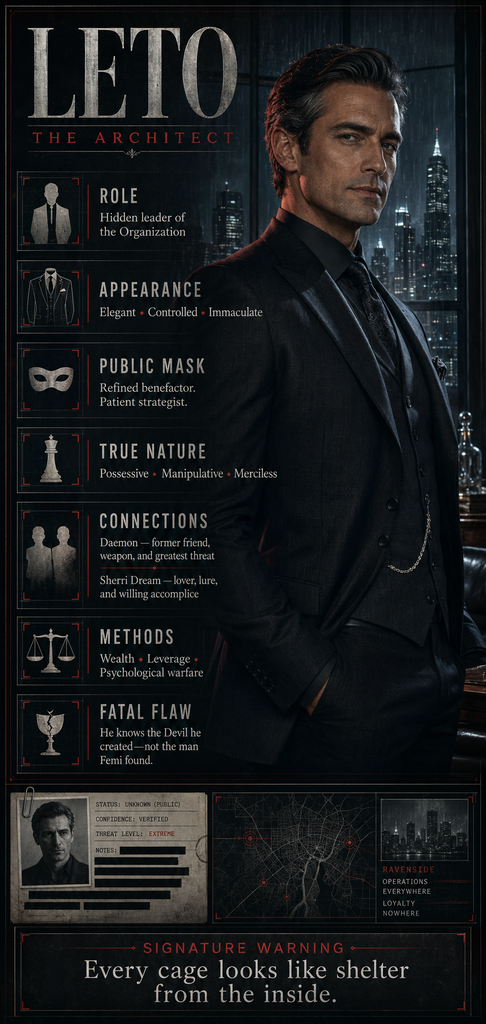
Leto
Alias: The Architect, The Man Behind the Organization
Species: Human
Age: 45
Hair: Dark, meticulously groomed
Eyes: Cold gray
Affiliation: The Organization
Role: Secret leader of the Organization, Daemon’s former friend, and architect of his destruction
Status: Active threat
Sigil: A black crown suspended above a broken chess piece
Physical Appearance
Leto possesses the kind of elegance that makes violence seem beneath him.
He is tall, lean, and immaculately composed, favoring tailored suits in dark, muted colors. Every detail of his appearance is deliberate—from the precise knot of his tie to the polished shoes that never seem to touch anything unclean. His dark hair is carefully groomed, and his gray eyes remain cool even when the people around him begin to panic.
He does not dress like a criminal.
He dresses like the man criminals report to.
Leto’s hands are rarely stained with blood because he has built an empire of people willing to spill it for him. His stillness is not the guarded quiet of Daemon or Femi. It is the confidence of a man who believes the room already belongs to him.
He seldom raises his voice. He does not need to. His displeasure is conveyed through pauses, unfinished sentences, and the subtle withdrawal of warmth. Those who know him understand that his calmest expression is often the final warning they will receive.
Personality
Leto is intelligent, patient, charismatic, and profoundly controlling.
He understands systems better than people—or, more accurately, he understands the weaknesses that allow people to become systems. He studies ambition, fear, loyalty, greed, and love as mechanisms that can be manipulated. Once he discovers what a person wants, he decides how that desire can be converted into obedience.
Leto rarely forces someone to serve him when he can persuade them that service was their own idea.
He is cultivated, articulate, and capable of appearing generous. He rewards loyalty extravagantly, protects those who remain useful, and remembers personal details well enough to create the illusion of genuine intimacy. His followers do not merely fear him. Many believe he sees their potential more clearly than anyone else ever has.
That belief is carefully manufactured.
Leto does not see people.
He sees functions.
A politician is access. A police officer is protection. Sherri is bait. Daemon was a weapon.
Leto’s affection is inseparable from possession. He can care for someone, perhaps even love them, but only while they remain within the role he has assigned them. Independence feels like betrayal. Change feels like theft.
No one is permitted to become something Leto did not authorize.
Public Mask
To the outside world, Leto is a wealthy, respectable man with influence in business, politics, and private security.
His name appears on charitable donations, investment portfolios, and invitations to rooms where powerful people decide the futures of those beneath them. He cultivates relationships with judges, politicians, law-enforcement officials, and corporate leaders, ensuring that the Organization’s interests are protected by people who may never understand the full machinery they serve.
Most members of the Organization do not know Leto is its true leader.
He has constructed layers of command between himself and the crimes committed in his name. Orders descend through intermediaries. Money passes through legitimate businesses. Bodies disappear into graves known only to men who are later silenced.
If one section of the Organization falls, Leto remains untouched.
To his associates, he is a patron.
To his enemies, he is a rumor.
To Daemon, he is the man who once called himself a friend.
True Nature
Leto is the architect of a criminal empire built upon blackmail, bribery, trafficking, political corruption, murder, and human experimentation.
He does not indulge in cruelty merely for pleasure. His cruelty is purposeful, measured, and frequently disguised as necessity. Every death protects a secret. Every experiment pursues an advantage. Every betrayal removes a weakness from the structure he has created.
This makes him more dangerous than a man driven by rage.
Rage can be anticipated.
Leto’s calculations cannot.
He is capable of ordering the destruction of an entire family and discussing the matter over dinner without losing his appetite. He does not regard himself as evil because he considers morality a luxury invented by people without sufficient power.
To Leto, there are only outcomes.
Everything else is sentiment.
History with Daemon
Before Daemon became the Organization’s most feared executioner, he and Leto were friends.
They rose together through the criminal underworld, although they possessed very different gifts. Daemon inspired terror through direct violence. Leto inspired obedience by controlling where that violence was directed.
Daemon helped clear Leto’s path to power. He killed rivals, eliminated witnesses, buried secrets, and carried out orders no other man could survive. Because Daemon answered directly to Leto, few members of the Organization ever knew who truly commanded the Devil.
Leto encouraged this arrangement.
He allowed Daemon to become the visible nightmare while he remained safely beyond sight.
In return, Daemon received something he had rarely known: purpose, trust, and the illusion of brotherhood.
Leto exploited all three.
He praised Daemon’s strength while quietly isolating him from everyone who might have reminded him that he was still human. He taught Daemon to mistake usefulness for belonging and obedience for loyalty. Whenever Daemon questioned an order, Leto framed hesitation as weakness. Whenever Daemon obeyed, Leto called him extraordinary.
He did not simply command the Devil.
He helped create him.
That is why Leto believes Daemon belongs to him.
The Experiment
Daemon eventually became too powerful, too knowledgeable, and too difficult to control.
He knew the burial sites.
He knew which politicians had been bought, which officers had been compromised, and which respectable men had built their lives upon the Organization’s blood. More dangerously, he knew Leto’s identity.
No prison could hold him.
No ordinary execution could guarantee his silence.
Leto therefore chose to make Daemon useful one final time.
The Organization had begun conducting human experiments intended to test the limits of physical endurance and create operatives capable of surviving extreme punishment. The procedure was considered unsurvivable.
Leto volunteered Daemon.
He described the sacrifice as necessary, but necessity was only part of the truth. Daemon had become a threat to Leto’s authority. The weapon had begun thinking like a man, and Leto could not tolerate the distinction.
With Sherri’s help, Daemon was lured into a limousine where the Organization’s men were waiting. He was restrained, delivered to the experiment, and abandoned when his body appeared unable to survive what had been done to it.
Leto believed the Devil was dead.
For twelve years, that belief allowed him to sleep peacefully.
Then Sherri sent him a photograph from Helix.
Leto recognized Daemon’s eyes.
And the past opened its own grave.
Relationship with Sherri Dream
Leto seduced Sherri while she was still involved with Daemon.
He offered her what Daemon could not: wealth, beautiful clothes, expensive jewelry, social influence, and the appearance of safety. Where Daemon’s danger was visible, Leto’s was concealed beneath polished manners and controlled generosity.
Sherri believed she was leaving a monster for a gentleman.
In truth, she merely chose the monster who wore gloves.
Leto showed her evidence of Daemon’s executions and encouraged her fear. He did not need to invent Daemon’s brutality; he only removed his own orders from the story. Every body became proof of Daemon’s nature rather than evidence of the empire Leto had used him to build.
By the time Sherri understood the truth, she had already betrayed Daemon and made herself valuable to Leto.
Their relationship is built upon luxury, fear, ambition, and mutual deception. Leto provides Sherri with status as long as she remains useful. Sherri offers loyalty while quietly imagining how she might survive his fall.
He knows she is ambitious.
She knows he is capable of killing her.
Each mistakes awareness for protection.
Leto sends Sherri to Helix because she is one of the few people capable of reaching Daemon through his past. He expects her to awaken old guilt, old desire, and the reflexive loyalty of the man who once loved her.
Sherri is not merely his lover.
She is the bait he has used twice.
Relationship with Femi
At first, Leto does not consider Femi significant.
She is small, quiet, and apparently removed from the violent world Daemon once inhabited. Leto assumes she is a temporary attachment—a fragile woman Daemon protects because he has become sentimental.
He is wrong.
Femi is not Daemon’s weakness.
She is the reason his strength finally belongs to him.
Leto gradually recognizes that Daemon’s devotion to Femi cannot be manipulated like his former loyalty to Sherri. Femi does not control Daemon through fear, guilt, ambition, or desire. She asks him to become nothing. She does not worship the Devil, nor does she recoil from the man beneath him.
She simply gives him somewhere to return.
That makes her dangerous to Leto.
Through Femi, Daemon has discovered a form of loyalty that is freely chosen rather than conditioned. He no longer needs Leto’s approval, the Organization’s purpose, or Sherri’s admiration to know who he is.
Leto cannot understand this transformation because he believes love is another hierarchy.
He assumes Femi must be controlling Daemon because Leto cannot imagine devotion without ownership.
When he abducts her, he expects Daemon to become reckless and obedient to the demands placed before him.
Instead, Leto unleashes a man who has finally chosen what he is willing to kill for.
Motivations
Leto wants control, preservation, and confirmation of his own superiority.
Daemon’s survival threatens more than the Organization. It threatens the story Leto has told himself for twelve years: that he was the cleverer man, that sentiment made Daemon weak, and that every piece remained where he placed it.
If Daemon survived the experiment, then Leto failed.
If Daemon built a life beyond the Organization, then Leto never truly owned him.
If Femi reached the man Leto tried to erase, then the Devil was never entirely Leto’s creation.
Leto therefore needs to draw Daemon back into the world they once shared. He wants the Organization to witness that the Devil still answers when its master calls.
Killing Daemon would protect his secrets.
Breaking him would restore Leto’s pride.
Forcing Daemon to return willingly would prove that no one—not even Femi—could undo what Leto made.
Leadership of the Organization
Leto governs through distance and compartmentalization.
Very few members know the full extent of the Organization’s operations. Fewer still know the identity of the man at its center. Cells are kept separate, leaders possess only partial information, and every important figure has enough evidence against them to make betrayal mutually destructive.
His authority rests upon three principles:
- Everyone must believe they are replaceable.
- No one may possess the complete truth.
- Fear is most effective when disguised as opportunity.
Leto rewards competence, but he never allows competence to become independence. Promising subordinates are promoted, compromised, and watched. Those who become too ambitious are given impossible assignments or exposed to law enforcement through carefully arranged failures.
He does not merely eliminate threats.
He causes them to destroy themselves.
Methods
Leto prefers manipulation to confrontation.
He creates false choices in which every available path benefits him. He gives people enough freedom to blame themselves for the decisions he designed. When he uses violence, it arrives through another person’s hands and appears to have originated somewhere else.
His preferred methods include:
- Psychological manipulation
- Strategic blackmail
- Political and judicial corruption
- Compartmentalized criminal cells
- Emotional leverage
- Manufactured betrayals
- Abduction and coercion
- Human experimentation
- Carefully staged executions
- Turning loved ones into weapons
Leto knows that Daemon cannot be defeated through ordinary intimidation. He therefore targets the people surrounding him, particularly Femi and Malone, hoping to transform devotion into predictable behavior.
His greatest talent is making a trap resemble a choice.
Strengths
Leto is exceptionally patient.
He can wait years for a threat to become vulnerable and months for an enemy to make the precise mistake he anticipated. He thinks beyond individual confrontations, preparing alternate strategies and expendable layers of protection.
He is also charismatic. People want to impress him, even when they fear him. He makes subordinates feel briefly important, encouraging them to reveal more than they intended in pursuit of his approval.
His secrecy is another formidable defense. Because most of the Organization does not know he is its true leader, removing individual members rarely damages him directly.
Most importantly, Leto understands Daemon’s past.
He knows the orders Daemon obeyed, the bodies he buried, the people he failed, and the guilt he carries. He knows which words once commanded the Devil and which memories can still draw blood.
That knowledge makes him dangerous.
It does not make him correct.
Weaknesses
Leto’s greatest weakness is his belief that people cannot truly change.
He views personality as machinery. Once he understands how someone operates, he assumes they will continue responding to the same pressures forever. He therefore approaches Daemon as the same wounded, obedient weapon he controlled twelve years earlier.
But Daemon has changed.
Femi has given him a life Leto did not design, a loyalty Leto cannot redirect, and a peace more powerful than the Organization’s approval.
Leto also mistakes emotional restraint for emotional absence. Because he rarely feels remorse, he regards love and grief as exploitable defects. He fails to understand that these emotions can become sources of endurance rather than openings for control.
His arrogance compounds every error.
Leto believes intelligence grants him distance from consequence. He is accustomed to watching other people fight on the board while he remains beyond reach. When Daemon finally forces him into direct confrontation, Leto loses the advantage upon which his empire was built.
He knows how to move monsters.
He has forgotten how to face one.
Internal Conflict
Leto insists that Daemon was merely a weapon.
His actions suggest otherwise.
He could have ordered Daemon’s death from a distance. Instead, he chose an experiment that transformed the execution into a demonstration. He needed Daemon to suffer. He needed the strongest man in the Organization to be reduced, restrained, and proven mortal.
That need was personal.
Some part of Leto once regarded Daemon as a brother. Another part envied the loyalty Daemon inspired and feared the raw power he possessed. Leto could command rooms, buy officials, and manipulate entire institutions—but Daemon could silence men simply by entering.
Leto needed Daemon.
He resented needing anyone.
The experiment was therefore both strategic removal and intimate betrayal. By sacrificing Daemon, Leto proved that intellect could defeat strength and that affection would never outrank power.
Daemon’s survival resurrects everything Leto tried to bury: dependence, jealousy, guilt, and the possibility that he destroyed the only person who had ever been truly loyal to him.
Rather than confront that truth, Leto decides to destroy him again.
Narrative Function
Leto is the embodiment of Daemon’s past refusing to remain buried.
He represents the system that turned violence into identity and obedience into belonging. Through him, the story reveals that Daemon did not simply work for the Organization. He was shaped by it, praised by it, and ultimately discarded by the man he trusted most.
Leto also serves as Daemon’s dark reflection.
Both men are intelligent, controlled, and capable of devastating violence. Both inspire fear without needing to raise their voices. But where Daemon’s love for Femi teaches him restraint, Leto’s obsession with control devours every relationship he possesses.
Daemon protects.
Leto possesses.
Daemon’s silence contains feeling too deep for easy expression.
Leto’s silence conceals the absence of remorse.
Leto forces Daemon to decide whether confronting the Devil means becoming him again—or choosing what that violence will serve.
Symbolism
Leto represents authorship corrupted into ownership.
He believes that because he helped create the Devil, he has the right to command him forever. His black crown symbolizes hidden rule: authority without visibility, power without accountability. The broken chess piece beneath it represents the people he sacrifices while convincing himself they were never more than pieces.
His immaculate clothing reflects the distance he maintains from the consequences of his orders. The blood does not stain him because someone else is always made to hold the knife.
He is civilization worn as camouflage.
He is betrayal offered with a steady hand.
He is the danger of believing that creating a monster means controlling what it loves.
Character Arc
Leto begins from a position of near-total control.
His Organization reaches into police departments, courts, politics, and the streets. His identity remains protected. Sherri enters Helix on command, and Daemon responds closely enough to expectation that Leto believes the old mechanisms still work.
The photograph confirming Daemon’s survival does not frighten him at first.
It excites him.
The Devil has returned, and Leto believes this gives him an opportunity to finish what the experiment began.
He uses Sherri to reopen old wounds, sends Daemon through a maze of abandoned buildings and false leads, and abducts Femi to force the final confrontation. Every step is intended to strip away Daemon’s new life until only the Organization’s executioner remains.
But Leto fails to understand what Femi has changed.
Daemon does not come because Leto summoned him.
He comes because Femi was taken.
By the time Leto realizes that the Devil standing before him no longer seeks his approval, his layers of protection have fallen. The Organization’s men are defeated. His escape is blocked. His carefully constructed distance disappears.
For the first time, Leto must face Daemon without intermediaries, leverage, or lies.
He draws a knife and challenges him directly.
Daemon answers with his bare hands.
The confrontation ends not simply with the fall of the Organization’s leader, but with the destruction of Leto’s central belief:
He did not create Daemon.
He only taught him how to kill.
Femi taught him what was worth living for.
Signature Quote
“Did you leave something precious where it could be stolen, my Devil?”
Character Warning
Leto does not enter a room expecting to defeat you.
He enters after arranging for everyone you trust to do it for him.